Unearthing Prehistoric Life: 10 Dinosaur Eggs Found in 150-Million-Year-Old Nest
Dinosaurs represent one of the most fascinating species that no human has ever witnessed alive. For generations, people have only encountered these magnificent creatures through cinematic spectacles like Jurassic Park or educational materials in schools and novels. According to the U.S. Geological Survey (USGS), dinosaurs last roamed the Earth approximately 66 million years ago, following an impressive reign of about 165 million years on our planet.
A Historic Discovery on Santa Cruz Beach
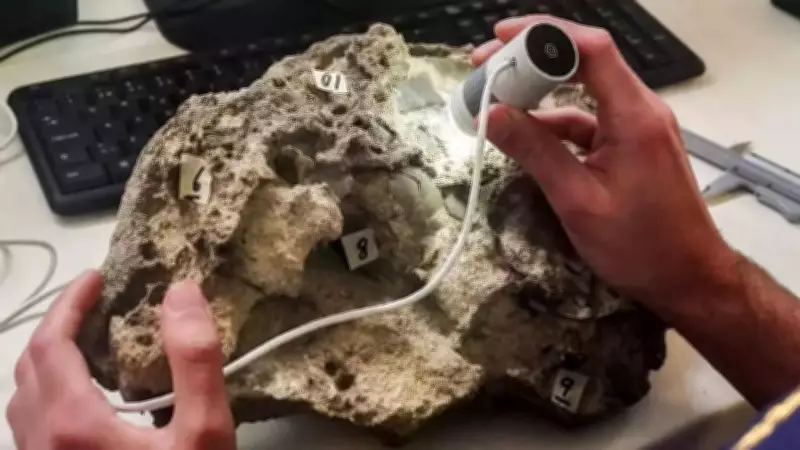
Now, a groundbreaking discovery has emerged from the cliffs of Santa Cruz Beach, located in the municipality of Torres Vedras within Portugal's Lisbon district. Researchers have uncovered a nest containing 10 dinosaur eggs, dating back an astonishing 150 million years. This finding provides a rare and invaluable window into prehistoric life during the Upper Jurassic era.
The remarkable discovery was made by Carlos Natário, an associate researcher at the Centre for Research in Paleobiology and Paleoecology (Ci2Paleo), which operates under the Torres Vedras Natural History Society (SHN) in Torres Vedras, Portugal. Preliminary observations indicate that the hatchlings successfully emerged from the eggs millions of years ago. However, researchers hypothesize that traces of unborn baby dinosaurs, or embryos, may still be preserved within some of the eggshells.

Scientific Significance of the Nesting Site
The discovery of 10 intact dinosaur eggs in a 150-million-year-old nesting site is exceptionally rare. One of the most scientifically significant aspects is that the eggs were not displaced by ancient floods or natural disasters. They were found in their original nesting pattern, suggesting that the Jurassic predator deliberately chose this riverbank location to lay its eggs.
According to the team at Ci2Paleo, several specific conditions had to align at the exact moment the eggs were laid:
- The eggs were discovered in granular sandstone, confirming that the predator likely laid them on a riverbank. This soft sand allowed the eggs to be gently buried by natural sediment shortly after deposition.
- The Torres Vedras Natural History Society (SHN) report highlights that the eggs were not moved by water. In typical scenarios, eggs would be scattered or destroyed by floods or other natural events. Scientists believe these eggs were fossilized precisely where the mother left them, with no movement contributing to their intact preservation rather than fragmentation.
From Fossils to Advanced Analysis
The initial discovery at Santa Cruz Beach was just the beginning. The heavy sandstone block containing the nest has been transported to the Torres Vedras Natural History Society (SHN) laboratory for a virtual excavation. To examine the eggs internally without causing damage, researchers are employing CT scans. This non-invasive advanced technique enables scientists to create high-resolution 3D models of the interior structures.
The primary objectives of the CT scans are to address two major scientific mysteries:
- Many eggs show signs that the babies inside successfully hatched, but there may still be evidence of embryonic bone remains.
- By analyzing the internal structure and microscopic porosity of the shells, researchers can identify which Jurassic predator laid the eggs.
Identifying the Jurassic Predator
As of now, the exact species remains unknown and is under rigorous analysis. Preliminary studies of the eggshells strongly suggest that the eggs belong to a carnivorous theropod. The eggs are relatively small, measuring barely 5 centimetres in diameter, characteristic of two-legged predators from the Jurassic era. The discovery of the eggs in a three-dimensional nest aligns with nesting behaviors commonly observed in meat-eating dinosaurs.
This discovery not only enriches our understanding of dinosaur reproductive habits but also underscores the importance of continued paleontological research in uncovering the secrets of Earth's ancient inhabitants.