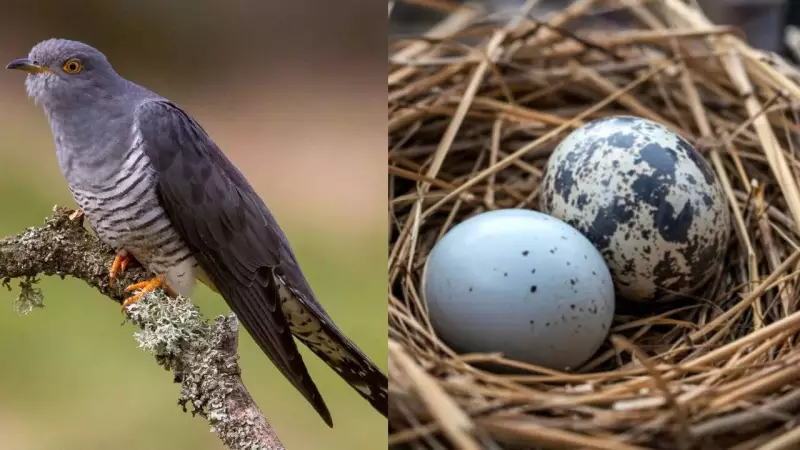
To a casual birdwatcher, the common cuckoo might appear to be the ultimate lazy parent in the avian world. Unlike most birds, it doesn't bother with the arduous tasks of gathering twigs, constructing a nest, or tirelessly feeding its hungry chicks. Instead, it employs a stealthy and cunning strategy: it quietly slips its egg into the nest of another bird, often a crow in parts of Asia, and flies away. This isn't a sign of neglect or a missing instinct, but a highly refined evolutionary tactic for survival.
The Evolutionary Logic Behind Avoiding Nest Building
For the cuckoo, survival and genetic success have never hinged on traditional parenting skills. It depends on precise timing, clever deception, and ruthless efficiency. By depositing its eggs in the nests of other species, a behaviour scientists term brood parasitism, the cuckoo completely avoids the massive physical cost of raising its young. This allows a single female to produce and distribute a much larger number of eggs across multiple nests in one breeding season.
What may seem like an unfair cheat is, in reality, the outcome of millions of years of evolution favouring this highly successful reproductive shortcut. A landmark, peer-reviewed study published in the journal Nature established that cuckoos using host nests gain a significant reproductive advantage, proving they are not random cheaters but specialists shaped by natural selection.
Why Crows Are the Chosen Foster Parents
Crows are not selected by chance. They possess a specific set of traits that make them ideal, albeit unwilling, foster parents. Crows are attentive, fiercely protective of their nests, and capable of feeding large, demanding chicks. Their nests are also typically large and sturdy, providing excellent concealment for the intruder's egg and later supporting the rapid growth of the cuckoo chick.
In some species, like the Asian koel (often confused with a true cuckoo), the deception is even more sophisticated. The koel's egg closely mimics the colour and size of a crow's egg, dramatically reducing the chance it will be detected and rejected by the host parents.
The Mechanics of a Successful Deception
The female cuckoo's operation is remarkably precise. She carefully observes the host birds, waiting for the perfect moment to strike. She often removes one of the host's own eggs to keep the total clutch size the same, making her addition less noticeable. The cuckoo egg usually hatches earlier than the others, giving the chick a critical head start.
Soon after hatching, the cuckoo chick exhibits a stark instinct: it will often push the host's eggs or chicks out of the nest. This brutal act ensures that all food brought by the hardworking foster parents is directed solely to the imposter. The host parents, driven by deep-seated parental instincts, continue to feed the large chick, responding to its begging calls which expertly mimic or even exaggerate the signals of their own offspring.
One might wonder why intelligent birds like crows fall for this trick. Rejecting a strange egg is a risky decision; a mistake could mean destroying one of their own. Furthermore, research has documented a phenomenon called the 'cuckoo mafia effect' where cuckoos may damage nests that reject their eggs. Faced with these potential costs, many crows tolerate the intruder, creating an ongoing evolutionary arms race between deception and defence.
In essence, the cuckoo does not build nests because it has evolved a better way. Its survival depends on exploiting the very parental instincts that are fundamental to other birds. By hijacking crow nests, cuckoos bypass the most energy-intensive phase of reproduction and focus entirely on spreading their genes as widely as possible. From a human perspective, it may seem cruel, but in nature, it is a story of efficiency—a strategy that has worked flawlessly for millennia.