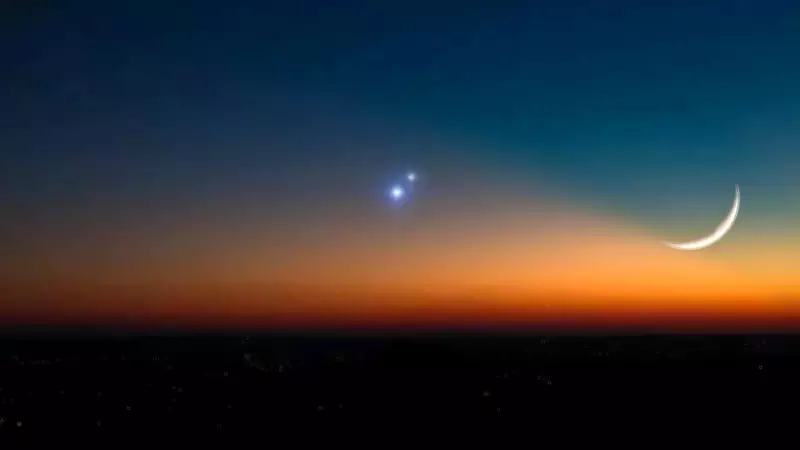
Venus and Jupiter to Create Spectacular 'Double Planet' Event in 2026
Imagine being able to observe other planets from Earth with nothing but your own eyes. While many might dismiss this as impossible, the summer of 2026 offers a unique opportunity for astronomy enthusiasts. Skywatchers will be treated to a dazzling display as Venus and Jupiter, the two brightest planets in our solar system, come together in a rare celestial event known as a 'double planet' conjunction.
What Is This Planetary Conjunction?
A planetary conjunction occurs when two celestial bodies appear exceptionally close in the sky from Earth's perspective, due to the alignment of their celestial coordinates. Despite seeming to touch, they remain separated by hundreds of millions of kilometers in space. This phenomenon is a visual illusion created by their positions along the same line of sight.
According to NASA's Watch the Skies program, the Venus-Jupiter conjunction will peak on June 8-9, 2026. At its maximum visibility, the planets will be only about 1.38 degrees apart—roughly the width of a pinky finger held at arm's length. This close proximity will make them look like a single, brilliant beacon in the twilight sky.

Why Are Venus and Jupiter So Bright?
Venus and Jupiter are the brightest objects in the night sky after the Sun and Moon. Venus shines intensely because its thick cloud cover reflects approximately 70% of sunlight, while Jupiter's massive size allows it to reflect significant light despite its greater distance from Earth. Their combined brightness ensures they will be easily visible, even in areas with moderate light pollution.
How to Watch the 'Double Planet' Display
This event will be best viewed shortly after sunset in the west-northwest sky, with a narrow window of about one hour before the planets set below the horizon. To maximize your chances of seeing this spectacle, follow these recommendations:
- Find an Unobstructed View: Ensure your viewing spot has a clear line of sight to the western-northwest horizon, as the planets will be only 10 to 15 degrees above it. Avoid locations with tall buildings, trees, or mountains blocking the view.
- Use the 'Pinky Finger' Rule: Extend your arm and hold out your pinky finger; the distance between Venus and Jupiter will be slightly less than its width, helping you locate them as a close pair.
- No Equipment Necessary: While binoculars can reveal details like Jupiter's moons or Venus's phases, this event is perfectly visible to the naked eye due to the planets' exceptional brightness.
This conjunction is a reminder of the dynamic nature of our solar system, where planets act as both permanent sentinels and seasonal visitors in the sky. Mark your calendars for June 2026 to witness this extraordinary astronomical event.