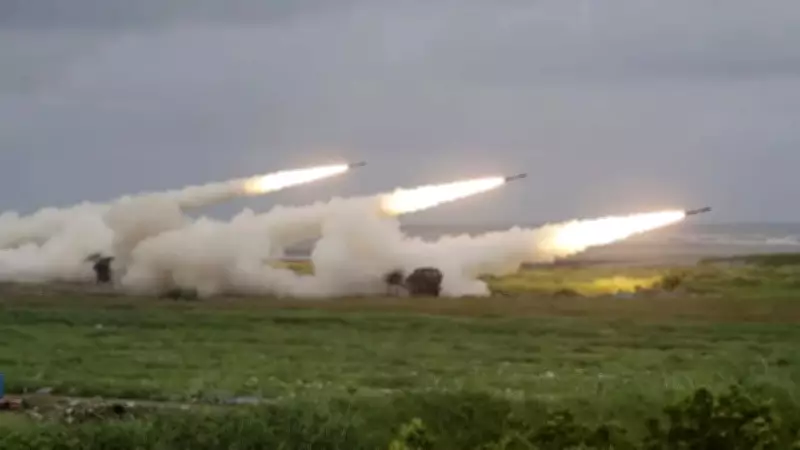
Taiwan on Wednesday conducted its first-ever live-fire HIMARS (High Mobility Artillery Rocket System) exercise in the Taiwan Strait. The US-supplied HIMARS showcased its ability to rapidly strike and relocate using the 'shoot-and-scoot' tactic.
Drill Details
The drill was conducted on Taiwan's western coast facing mainland China, forming part of a larger exercise simulating a Chinese invasion. 'Due to the current enemy threat, we will continue HIMARS training with unwavering determination to protect Taiwan as the nation's strongest force,' said Army Sgt Wang Ming Hui.
Understanding 'Shoot-and-Scoot'
The shoot-and-scoot tactic is a battlefield strategy designed to keep artillery and rocket systems safe and hidden from enemy drones, satellites, and surveillance aircraft. Under this tactic, the launcher is hidden in tunnels, forests, and urban areas to conceal its position until it receives a firing order. After receiving firing orders, it quickly moves to its designated firing position and launches its projectile within minutes, then immediately relocates before enemy forces can pinpoint its location and launch a counterattack.

The HIMARS is particularly suited for this tactic, as it is mounted on a six-wheeled truck, allowing it to move rapidly across roads and rough terrain. For Taiwan, the tactic is especially important because of China's overwhelming military superiority.
Strategic Importance
In the event of a Chinese invasion, Taiwan's missile batteries, command centres, and air bases would be the first targets that China will likely attempt to neutralise. The shoot-and-scoot tactic is expected to increase the survival of Taiwan's rocket force and allow them to operate in a prolonged conflict. By constantly changing position, launchers could continue to target Chinese troops' positions, landing crafts, and logistics hubs.
Background of the Conflict
The drill comes at a time of growing military pressure from China, which is increasing its naval and air activities around the island in recent years. The conflict between China and Taiwan traces its roots to the Chinese civil war in 1949. The communist forces under the leadership of Mao Zedong defeated the nationalist government and established the People's Republic of China on the mainland, while the nationalist government retreated to Taiwan. Since then, China has considered Taiwan a breakaway province and vows to reunify it with mainland China. Taiwan continues as a self-governing democracy with its own government, military, and political system.
Taiwan's Defence Strategy
By showcasing the tactic, Taiwan is trying to highlight a strategy centred on mobility, survivability, and precision strikes rather than conventional military strength. As China continues to increase pressure on Taiwan, systems like HIMARS are expected to play a crucial role in Taiwan's defence planning. Taiwan intends to make any military operation against it as difficult, costly, and unpredictable as possible.