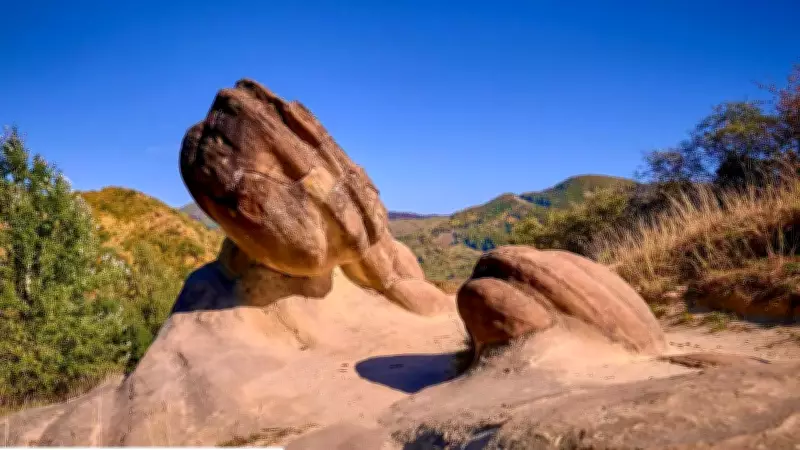
Romania's Living Rocks: The Geological Mystery of Growing Trovant Stones
In the serene landscapes of southern Romania, a remarkable geological phenomenon captures the attention of scientists and visitors. Scattered across open fields and woodland edges, rounded sandstone formations known as trovants present a fascinating spectacle. These stones are often described as living rocks due to their apparent ability to grow and, in some instances, produce smaller offshoots that separate from the main body.
A Protected Geological Treasure
The most renowned examples of these unique formations are located near the village of Costeşti in Vâlcea County. Here, a protected site called the Muzeul Trovantilor preserves several large specimens for study and observation. Classified as cemented sandstone concretions, these structures were formed millions of years ago through natural geological processes.
While local folklore has long woven tales around these mysterious stones, geologists provide scientific explanations for their unusual shapes and gradual expansion. The growth is attributed to chemical and sedimentary processes rather than any biological activity, making them a subject of steady scientific interest.

Ancient Origins and Formation
Geologists trace the origins of trovants back to the Middle Miocene period, more than five million years ago. During this era, parts of what is now Romania were shaped by rivers and shallow waters, where layers of sand accumulated and were subsequently compacted over millennia.
The stones consist of sand grains bound together by calcium carbonate, forming a limestone cement that hardened underground around a central core. Earthquakes may have contributed to shaping and compressing this material. Through gradual erosion, these rounded masses eventually became exposed at the surface, revealing their distinctive forms.
The Slow Process of Growth
Unlike typical rocks that gradually wear down through weathering, trovants exhibit a unique capacity to expand in size. This growth occurs through a subtle process involving mineral deposits. During periods of heavy rainfall, the porous stone absorbs water containing dissolved calcium carbonate.
As this mineral-rich water moves through the rock's structure, calcium carbonate accumulates near the surface, creating additional cementation. Under certain conditions, pressure builds unevenly within the stone, causing small bulges to form on specific areas. Over extended periods, these bulges can enlarge and eventually detach, creating what appears to be smaller baby rocks beside the original formation.
The growth rate is exceptionally slow, with estimates suggesting only a few centimeters of expansion over many centuries. This gradual process makes direct observation challenging but contributes to the stones' mysterious reputation.
Folklore and Cultural Significance
The unusual appearance and behavior of trovants have inspired rich local folklore throughout history. Some residents once believed the stones were fossilized dinosaur eggs or remnants of extraterrestrial activity. The term trovant itself was introduced by a Romanian naturalist and translates roughly to cemented sand.
Additional stories suggest the rocks possess the ability to move, drawing comparisons to the famous sailing stones of Death Valley in the United States. While conclusive evidence of movement remains limited, some researchers speculate that slight shifts might occur as surrounding soil expands and contracts during temperature cycles.
Enduring Scientific Interest
Today, trovants continue to intrigue geologists and visitors as remarkable natural formations. No longer shrouded in complete mystery, these stones stand as testament to Earth's dynamic geological processes. They silently witness the passage of time in the fields near Costeşti, where they were shaped by water long before human presence.
The study of trovants provides valuable insights into sedimentary processes, mineral deposition, and the long-term effects of environmental conditions on geological formations. As research continues, these living rocks remain a captivating example of nature's ability to create phenomena that blur the line between the static and the dynamic.