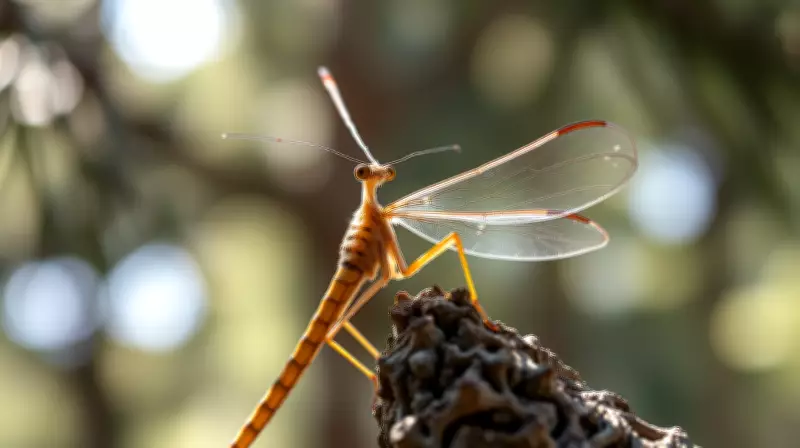
A resident in Inverness recently looked out into their garden and spotted a long-necked, translucent-winged insect rearing its flat head skyward like a miniature cobra mid-strike. This was not an ordinary garden visitor; it was a pine snakefly, Atlantoraphidia maculicollis, the only species of snakefly ever recorded in Scotland. This insect has been on Earth in essentially its current form since the Jurassic period and spends almost its entire adult life high in the pine tree canopy, making such a sighting extremely rare.
What is a Snakefly?
Snakeflies belong to the insect order Raphidioptera, meaning needle-wing, and are among the most primitive insects that undergo complete metamorphosis. The order contains over 200 known species worldwide, but only four have been recorded in the UK. Three are found south of the Scottish border: the Oak Snakefly (Phaeostigma notata), the Small Snakefly (Xanthostigma xanthostigma), and the Scarce Snakefly (Subilla confinis). Only the Pine Snakefly has been confirmed in Scotland, though it also occurs in parts of southern England and Wales.
The snakefly gets its common name from its elongated pronotum, the section between head and wings, which is highly mobile and can be raised so that the insect resembles a small snake preparing to strike. In German, they are called Kamelhalsfliegen: camel-neck flies. The head is broad and flat, the neck long and black, and the posture when alarmed is unmistakably serpentine. Snakeflies are often described as living fossils because of their close resemblance to species from the Jurassic period, over 140 million years ago.

Why Are Pine Snakefly Sightings in Scotland So Rare?
Pine snakeflies live at the top of trees and are rarely seen at lower levels. According to the Royal Entomological Society, adults spend much of their time high in the canopy, and any snakefly encountered by a casual observer has most likely been dislodged by strong winds. Newly emerged specimens occasionally appear at lower levels, and females descend briefly to lay eggs, but otherwise, this insect lives where most people never look.
Buglife Scotland confirmed that Atlantoraphidia maculicollis is the only snakefly species ever found in Scotland and is probably under-recorded because of its tree-topping habit. The charity noted that the insect is associated specifically with pine trees, where it lives in the upper canopy and is rarely encountered even by entomologists actively searching for it. The Buglife Scotland Species Knowledge Dossier on Raphidioptera reinforces this, confirming that formal records in Scotland are genuinely sparse.
How the Pine Snakefly Hunts, Breeds, and Raises Its Young
Despite its alarming appearance, the snakefly is entirely harmless to humans. Adults and larvae feed on aphids, scale insects, springtails, and other small invertebrates. Adults also supplement their diet with pollen. Larvae are found under tree bark, where they hunt and prey on other insects. The Lacewing and Allies Recording Scheme notes that adults can be reliably identified in the field and from good-quality photographs.
Females carry a long, needle-like ovipositor used to deposit eggs into tiny cracks in tree bark. Eggs hatch within roughly three weeks, and larvae pupate in autumn or the following spring, with adult flies typically emerging in May. The ovipositor is often as long as the female's entire abdomen, extending visibly beyond the wingtips. The iNaturalist UK database currently holds only 24 observations for this species across the whole of the UK, reflecting how rarely it is encountered and photographed.
What the Inverness Sighting Tells Us
Scotland's surviving fragments of ancient Caledonian pine forest in areas like Speyside, Deeside, and the Great Glen represent the habitat that Atlantoraphidia maculicollis depends on. Scots pine (Pinus sylvestris) is the species with which the pine snakefly has the strongest known association. That a specimen turned up in a suburban Inverness garden rather than a remote woodland clearing is informative. It suggests either that pine trees within or near the garden provided the insect's usual canopy habitat, or that wind or natural dispersal brought it down from nearby stands.

This sighting is a reminder that urban and suburban green spaces are connected to ecological systems around them. Sometimes that connection is made visible by an insect that looks like it wandered in from the Jurassic period. For a creature that has survived unchanged through the extinction of the dinosaurs, it is surprisingly easy to walk past without ever knowing it exists.