Manipur Conflict Escalates as Naga Groups Drawn into Ethnic Unrest
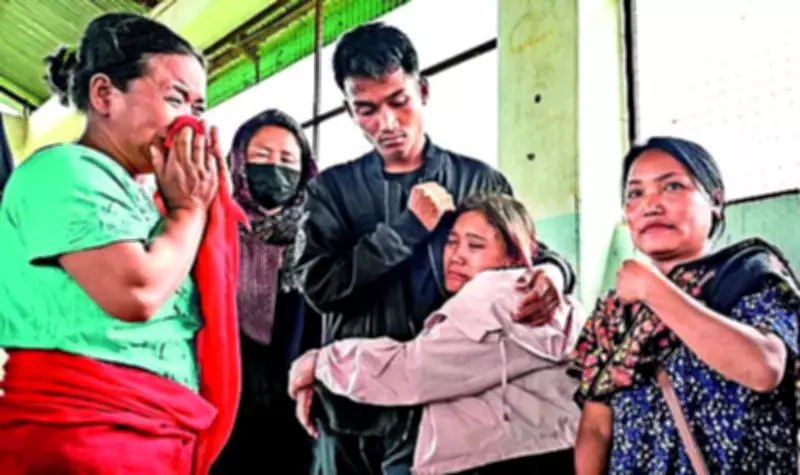
Guwahati: Manipur’s ethnic unrest, which began three years ago between the Meitei and Kuki-Zo communities, has hardened into entrenched hostility and widened to include Naga groups, particularly in the Ukhrul and Kangpokpi districts. The fresh conflict between the Tangkhul Naga and Kuki communities has its roots in Litan in Ukhrul district in February this year, when a Tangkhul Naga was assaulted by some Kuki youths in a drunken brawl. Since then, at least people from both sides have been killed. The last incident involved the killing of three Kuki-Zo Church leaders in Kangpokpi on Wednesday, and within hours, a Chiru Naga was shot dead in Noney district.
In both cases, the killers have not been officially identified. However, the Kuki-Zo community alleges that the Naga armed group, Zeliangrong United Front (ZUF), was behind the killing of the Church leaders. The ZUF-Kamson faction has denied this. On the other hand, the Naga allege that the Noney killing was carried out by Kuki-Zo militants in retaliation.
The state’s demographic divide has always been stark, with the valley, home to the Meiteis, accounting for 57% of the population, while the hills, inhabited by Nagas, Kukis, and other tribes, make up the remaining 43%. The state government appears to be losing its grip, as it has not been able to break the cycle of clashes, nor has it delivered on reconciliation mechanisms. With the Naga-Kuki faultline reopening and tensions rising, there is a risk of the unrest spiralling into a prolonged conflict reminiscent of the 1990s.

The state was engulfed in one of the worst inter-tribal conflicts when Kuki clashed with Naga between 1993 and 1998, claiming over 1,000 lives, destroying hundreds of villages, and displacing thousands. Lieutenant General Rana Pratap Kalita (retired), who was the General Officer Commanding-in-Chief of the Eastern Command during the peak of the Meitei-Kuki conflict, believes that some parties with vested interests want the Naga also to be involved in this ongoing conflict. He did not rule out the possibility of external elements trying to do so.
“It looks like manipulations are going on to get the Naga involved. Many external agencies appear to be involved. But why Nagas are being drawn out is beyond any simple logic. It is not in Kuki interests to get the Naga involved. They would be squeezed between Meitei and Naga,” he said. The general added, “There are certain parties who do not want Manipur’s problems to be resolved. In fact, they now seem intent on drawing the Nagas into the conflict to exacerbate it further. Who exactly constitutes these parties is anybody’s guess — it remains open-ended for now?”
He further stated, “If you look at the wider picture and link it with the arrests of US and Ukraine individuals who had travelled to Myanmar through Mizoram to train people across the border, questions arise: who did they train and how many of them were in Myanmar? We simply do not know. What is clear is that everybody seems to be playing their own game, and I firmly believe that some external agencies are involved too.”
Apart from domestic elements, restive Manipur now has a new player with insurgents from Myanmar joining the ethnic conflict. Top defence sources confirmed the incursion of Myanmar’s Kuki National Army-Burma recently in Kamjong district, where they carried out attacks in three Tangkhul Naga villages along the India-Myanmar border. The KNA works in coordination with the anti-junta armed group People’s Defence Force. “The KNA-B helped the Village Volunteers Eastern Zone in attacking three Tangkhul Naga villages in Kamjong district on May 7,” the defence official said.