The Diocese of Mangalore is progressively moving away from permanent graves due to an acute shortage of cemetery space. The diocese is employing steep pricing and policy changes to discourage the practice, which occupies land for generations. Although the diocese has approached the government seeking land for cemetery use, it is still awaiting a response.
High Costs and Limited Spaces
At Bejai Church, reserving a permanent grave now costs around Rs 3 lakh, with families also required to pay half that amount for each burial. One grave can accommodate up to five family members, an increase from one earlier and then three. Despite these steep charges, many parishioners continue to seek permanent graves, often viewing them as a status symbol.
Fr JB Saldanha, parish priest of Bejai Church, stated that the parish is preparing to end the permanent grave option altogether, with the decision resting with the parish council. "Those already taken will be continued, instead we are encouraging shroud burial and normal burials at our cemetery," he said. The parish records nearly 60 deaths annually.

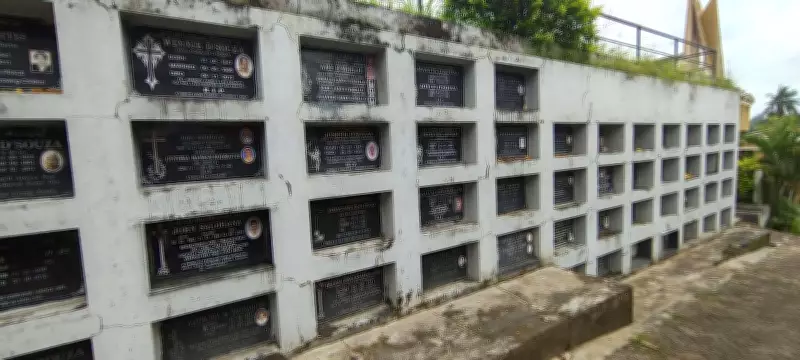
Around 15 years ago, a permanent grave cost about Rs 50,000. Today, the cost has increased several-fold in some parishes. At St Sebastian Church, the permanent grave system has already been discontinued. Parish priest Rev Fr Walter Dsouza explained that the church now offers common burials, vault burials, and niche burials, encouraging the latter as it requires the least space. Niches are permanent above-ground compartments for cremated remains, while vaults are above-ground burial chambers designed to hold coffins or remains. "The parish records nearly 90 deaths annually, and cemetery land has become scarce," he added, noting that while a permanent grave earlier cost around Rs 1 lakh, a niche burial box now costs about Rs 20,000.
Alternative Burial Systems
Most Holy Redeemer Church introduced the vault system years ago due to limited cemetery space, according to parish priest Rev Fr Joseph Martis. At Our Lady of Miracles Church, the permanent grave system was discontinued in 1992. Parish priest Rev Fr Bonaventure Nazareth said the church follows a common burial system, while allowing families to choose burial spots. The parish also offers vault and niche burial facilities. "With nearly 500 deaths recorded over the last decade, permanent graves are no longer feasible," he stated.
There is also growing interest in cremation. Although permitted by the Vatican since 1963, cremation was rarely chosen in the past. Diocese records show the highest number of cremations at Milagres Church, followed by Valencia, Bejai and Bendur.
According to Rev Fr Peter Paul Saldanha, Bishop of Diocese of Mangalore, permanent graves are being discouraged because land is limited, and future burial needs have to be addressed. "At the same time, we are trying to see whether additional land can be made available for cemetery use," he added.