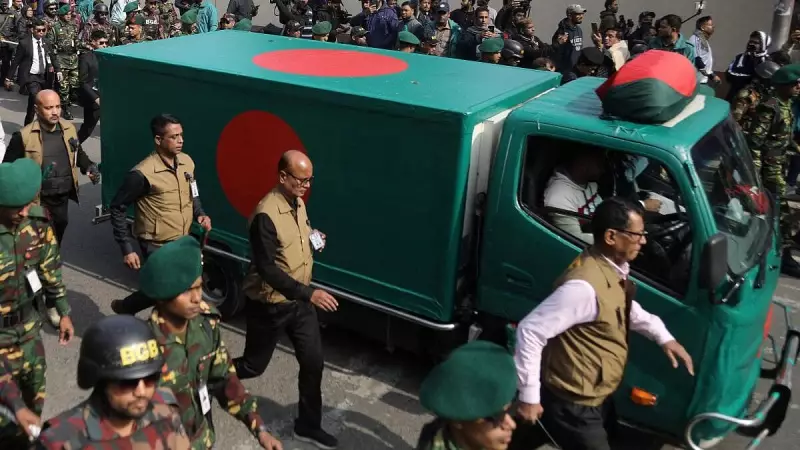
The final rites for Begum Khaleda Zia, the former Prime Minister of Bangladesh and a towering figure in the country's political landscape, were conducted on Thursday under a blanket of stringent security. The funeral prayer, or namaz-e-janaza, was held at the historic National Eidgah ground in the capital, Dhaka, drawing a massive crowd of mourners, supporters, and political leaders.
A Nation Bids Farewell to a Political Icon
Khaleda Zia, who served as the country's first woman prime minister and chaired the Bangladesh Nationalist Party (BNP), passed away on Wednesday at the age of 79. Her death marked the end of an era in Bangladeshi politics. The funeral proceedings began at her residence in Dhaka's Gulshan area, where her body was kept for a final viewing. From there, it was transported in a solemn procession to the National Eidgah for the public funeral prayer.
The government deployed a significant number of law enforcement personnel around the Eidgah and along the procession route to maintain order. Authorities had anticipated large gatherings and potential unrest, given Zia's polarizing legacy and the current tense political climate in Bangladesh. Despite the heavy security presence, the atmosphere was largely described as one of grief and solemnity as thousands gathered to pay their last respects.
Political Leaders and Public Mourners Gather
The funeral saw attendance from a cross-section of society. Senior leaders from the BNP and its allied parties were present in full force. Notably, members from other political factions and civil society also joined the congregation, highlighting Zia's significant impact on the nation's history. Her son and BNP's acting chairman, Tarique Rahman, who lives in exile in London, was notably absent, a poignant reminder of the family's fractured political journey.
Following the prayers at the Eidgah, Khaleda Zia's body was taken to the Banani Graveyard for burial. She was laid to rest beside the grave of her son, Arafat Rahman Koko, who died in 2015. The burial was a private family affair, concluding the public ceremonies for the leader whose life was inextricably linked with the democratic struggles of Bangladesh.
Legacy of a Former Prime Minister
Khaleda Zia's political career was marked by both significant achievement and intense controversy. She first came to power in 1991, leading the BNP to victory and becoming Prime Minister. Her tenure, and subsequent terms, were periods of substantial economic growth but also allegations of corruption and authoritarian governance. Her long-standing rivalry with Sheikh Hasina, the current Prime Minister and leader of the Awami League, defined much of Bangladesh's contemporary political discourse.
In her later years, Zia faced serious legal challenges. She was convicted in multiple graft cases, which her party and supporters decried as politically motivated. Since 2018, she had been largely confined to her home in Gulshan under a special executive order that allowed her to receive medical treatment there instead of serving a prison sentence. Her health had been declining for several years, with reports of liver cirrhosis and other complications, ultimately leading to her admission to the hospital where she passed away.
The death of Khaleda Zia leaves a major vacuum in the opposition space in Bangladesh. The BNP, already struggling under government pressure and with its top leadership in exile or jailed, now faces the monumental task of navigating a future without its most recognizable and influential leader. Her passing is expected to have profound implications for the political dynamics in Bangladesh, especially in the lead-up to future elections.
As the nation absorbs the news, the scenes from Dhaka's National Eidgah ground stand as a powerful testament to her enduring influence. Whether viewed as a champion of democracy or a controversial figure, Khaleda Zia's role in shaping modern Bangladesh is undeniable, and her funeral marks the closing chapter of a definitive political life.