Crystal-Filled Dinosaur Eggs Discovered in China Contain No Fossilized Embryos
In a remarkable paleontological find, researchers in eastern China have uncovered fossilized dinosaur eggs that hold a surprising secret. Instead of containing the tiny bones of embryos, the eggs are filled with hollow spaces lined with clear crystals. This discovery, made in the Upper Cretaceous Chishan Formation within the Qianshan Basin of Anhui Province, offers new insights into fossil preservation and dinosaur egg classification.
Details of the Fossil Eggs and Their Formation
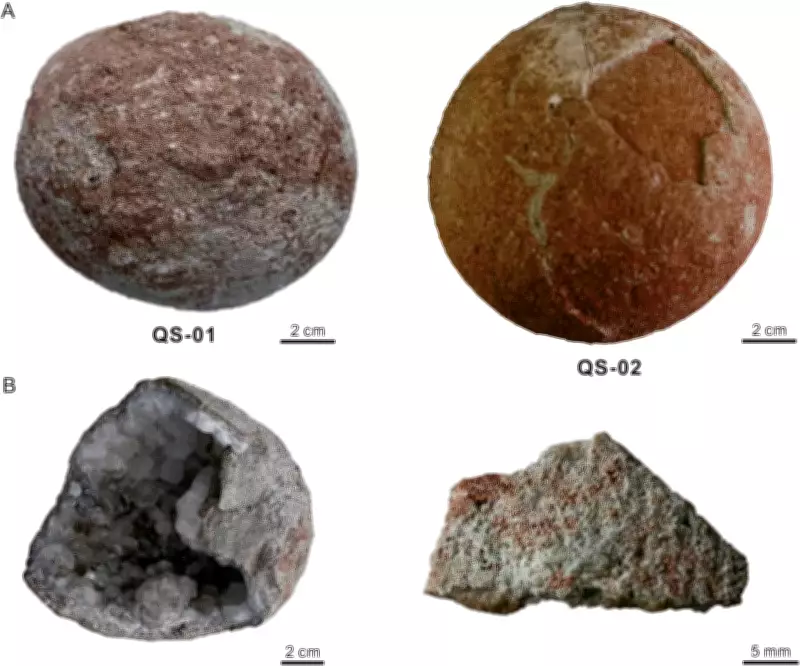
The two fossil eggs were found embedded in red sandstone layers and later cut open for detailed study. They are nearly round in shape, measuring approximately 10 to 13 centimetres in length, with shells up to 2.6 millimetres thick. While their outer appearance seems ordinary, microscopic examination revealed clear growth lines and tightly packed structures in the shell. Scientists have identified these eggs as a new oospecies, naming it Shixingoolithus qianshanensis. Notably, no embryo remains were preserved; only the shell and the minerals that formed inside after burial have survived.
According to a study published in the Journal of Palaeogeography, the crystals inside the eggs are composed of calcite. These crystals did not form while the egg was still alive. Instead, after the egg was buried in soil, water seeped through the ground, carrying dissolved minerals. Over a long period, the organic material inside the egg decomposed, leaving an empty space. Minerals gradually deposited in this hollow, forming clusters of crystals. This process is common in fossilization, where organic matter decomposes and minerals replace it or fill voids. In this case, the shell remains quite intact, while the embryo has completely vanished.

Identification of a New Oospecies and Geological Significance
Even without embryonic bones, the eggshell provided sufficient detail for identification. When thin slices were examined under a microscope, scientists observed uniform shell units and dense inner structures that differ slightly from known types. Due to these distinct features, the eggs were classified as a new oospecies within the Stalicoolithidae family. This marks the first time this group has been confirmed in the Qianshan Basin. While other regions in China have yielded many dinosaur eggs, this basin had previously offered little direct evidence, making this discovery particularly significant.
The eggs were found in layers formed by ancient rivers and lakes, dating back to the Late Cretaceous period, just before the mass extinction that ended the age of dinosaurs. Finding dinosaur eggs in these rocks supports the dating of the rock layers. Fossils like these help geologists confirm the age of sedimentary formations and understand how the region evolved over time. Currently, only two eggs are preserved, with one being incomplete. Nevertheless, they add valuable detail to the record of dinosaur life in eastern China, serving as quiet evidence from a distant past.