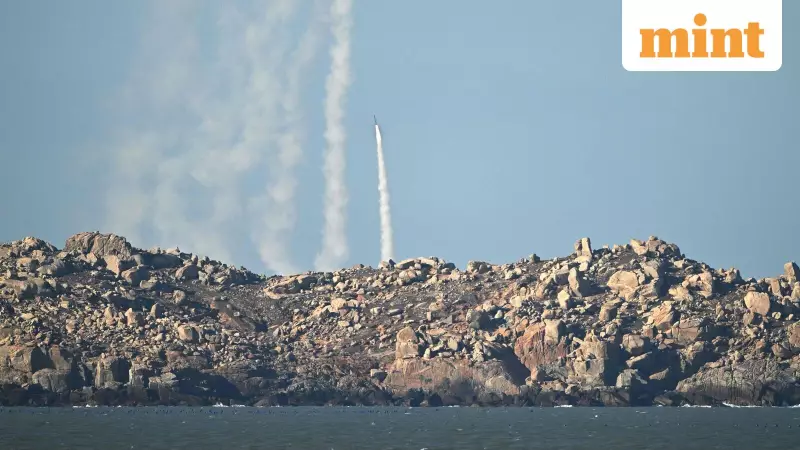
China's military this week conducted large-scale, multi-day exercises around Taiwan, dramatically escalating tensions in the Taiwan Strait. The drills, codenamed 'Justice Mission 2025', saw Chinese forces encircle the self-ruled island with jet fighters, naval ships, and coast guard vessels, while firing rockets into nearby waters. The operations, which ran from Monday to Wednesday, were described by Beijing as a stern warning against what it calls 'Taiwan independence separatists' and external interference.
A Display of Force and Strategic Intent
The scale and nature of the exercises sent a clear strategic message. China effectively blockaded Taiwan by warning aircraft and ships to avoid seven designated zones around the island. A significant development was the firing of 27 rockets from China's eastern coast on Tuesday. According to Taiwan's military intelligence official, Lt. Gen. Hsieh Jih-sheng, some of these landed closer to Taiwan's main island than ever before.
Military analysts see this as a rehearsal for isolating Taiwan. Lin Ying-yu, an associate professor at Taiwan's Tamkang University, noted that rockets with a range of over 120 miles could target the island's critical infrastructure, including supply lines, undersea internet cables, and LNG terminals. Professor Alessio Patalano of King's College London observed that the drills had dual objectives: establishing sea control within the strait and sea denial to its east, a clear signal to any external forces, particularly the United States.

International Reactions and Taiwan's Response
The drills were widely seen as a direct response to two recent events: the Trump administration's approval of over $11 billion in weapons sales to Taiwan in December, and Japanese Prime Minister Sanae Takaichi's November remarks about a potential 'Taiwan contingency'. Beijing's Defence Ministry explicitly warned against such 'external interference forces'.
When asked about the drills, former US President Donald Trump appeared dismissive, stating, 'Nothing worries me. They've been doing that for 20, 25 years.' However, the exercises prompted formal expressions of concern from the European Union, the UK, Australia, New Zealand, Japan, and several US lawmakers.
Taiwan, for its part, was not passive. Its military conducted rapid-response drills, deploying mobile missile units, displaying Patriot missile systems, and moving tanks. The coast guard and navy shadowed Chinese vessels to assert jurisdictional authority. Despite dozens of flight cancellations, shipping and energy imports were largely unaffected, and the Taiwan stock exchange's main index even gained 1% during the drill period.
The Long-Term Strategic Calculus
Experts believe 'Justice Mission 2025' is an intensified version of Beijing's long-running pressure campaign aimed at convincing Taiwan's populace of the futility of resistance. While China states a preference for peaceful unification, it continues to modernise its military at a rapid pace, expanding what is already the world's largest naval fleet.
The timing of the drills is also telling. Some analysts, like Tamkang University's Lin, suggest such a major operation requires at least two weeks of planning, meaning it was likely in motion before the US arms sales announcement on December 17. However, Professor Patalano warns that China is 'now in a position to enact large-scale exercises on short notice,' creating ambiguity for adversaries about whether an action is a drill or the prelude to an actual conflict.
The ultimate takeaway is that China's ambitions extend beyond Taiwan, projecting power past the 'first island chain' and challenging US supremacy in the Indo-Pacific. These drills underscore a persistent and growing threat to regional stability, keeping Taiwan and its allies on constant alert.