

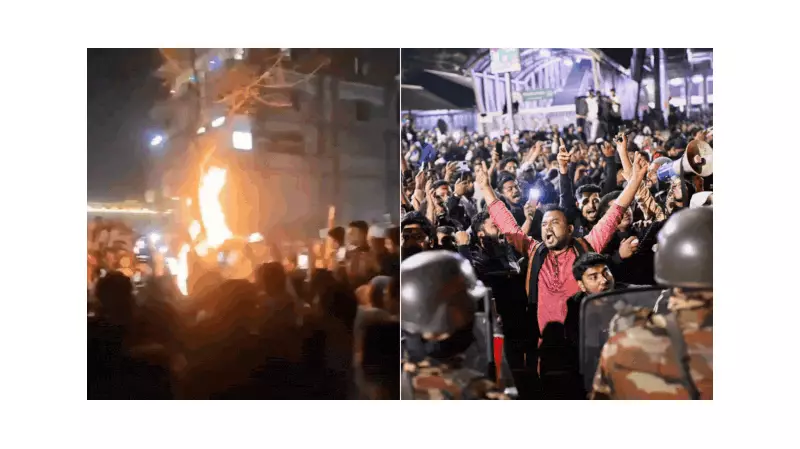
Bangladesh was plunged into a night of widespread violence and chaos following the death of a prominent youth leader from the country's 2024 pro-democracy movement. The passing of Sharif Osman Hadi, who succumbed to gunshot wounds in a Singapore hospital, triggered massive protests across the nation, with demonstrators demanding justice and turning their anger towards Indian diplomatic missions and the former ruling party.
Nationwide Protests and Anti-India Sentiment
Thousands of protesters flooded the streets of Dhaka late on Thursday and into Friday, their numbers swelling with grief and outrage. The demonstrations rapidly spread beyond the capital to other regions. A significant and troubling dimension of the unrest was the clear anti-India sentiment displayed by sections of the protesters.
In the southwestern city of Rajshahi, a crowd attempted to march towards the office of a regional Indian diplomat but was halted by police. Social media was flooded with videos showing incidents of stone-pelting near the Indian Assistant High Commission office. Earlier, on Wednesday in Dhaka, hundreds had tried to gather outside Indian diplomatic premises, including the residence of India's deputy high commissioner, leading police to use tear gas to disperse them.

The protests saw the involvement of the National Citizen Party (NCP), a major offshoot of the Students Against Discrimination (SAD) group that led last year's uprising. Leaders like Sarjis Alm of the NCP chanted anti-India slogans, alleging that Hadi's assailants had fled to India after the attack. Alm was quoted demanding that the interim government shut the Indian High Commission in Dhaka until the suspects were returned, declaring, "We are in a war!"
Escalating Violence: Media Offices and Political Properties Attacked
As the night progressed, the protests escalated into severe violence and arson. In the capital, several buildings were set ablaze, most notably the offices housing Bangladesh's two largest newspapers, Prothom Alo and The Daily Star. Fire officials confirmed at least three arson attacks, with reports of journalists and staff being trapped inside as firefighters battled the flames.
Witnesses described how several hundred demonstrators surrounded the Prothom Alo office around 11 pm before setting the nearby Daily Star office on fire. The violence was not confined to Dhaka. Protesters torched an Awami League office in Rajshahi and vandalised properties linked to former prime minister Sheikh Hasina, who fled to India after being ousted in the 2024 uprising.
Further disruptions included the blocking of a key highway connecting Dhaka with Mymensingh and an attack on the residence of a former minister in Chittagong, as shown in local media footage.
The Catalyst: Death of a Pro-Democracy Icon
The spark for this national upheaval was the death of Sharif Osman Hadi, aged 32. A senior leader of the student-led platform Inqilab Mancha and a vocal critic of Sheikh Hasina, Hadi was shot by masked assailants on December 12 while leaving a mosque in central Dhaka. He was later airlifted to Singapore for advanced treatment but succumbed to his injuries on Thursday.
Bangladesh's interim leader, Muhammad Yunus, described Hadi's death as an "irreparable loss for the nation," announcing a day of mourning and ordering special prayers nationwide. In response, police have launched a nationwide manhunt, releasing photographs of two suspects and offering a reward of five million taka for information leading to their arrest. Authorities have warned that the ongoing violence risks destabilising the country's fragile political transition.
The situation has drawn attention from India, where a parliamentary committee on external affairs noted the "complex and evolving" scenario in Bangladesh. The committee highlighted the uncertainty around democratic elections and pointed to significant instability since the political events of August 2024, with violence and intimidation against minorities, tribal communities, and media becoming commonplace.






