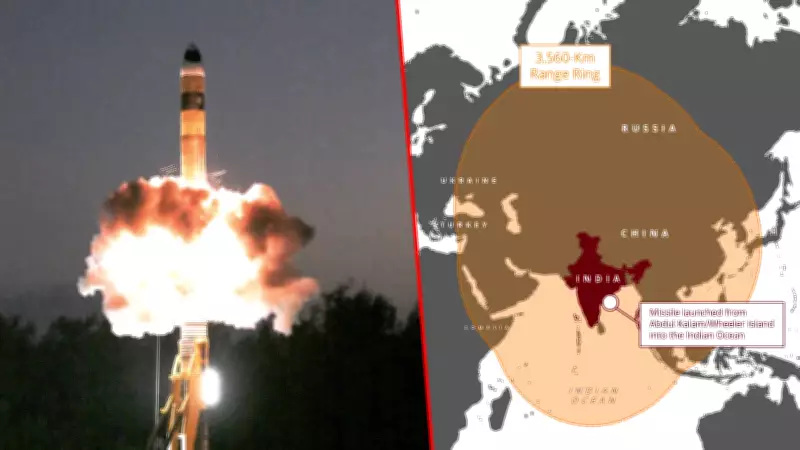
India has successfully tested an advanced Agni-5 missile equipped with MIRV (Multiple Independently Targetable Re-entry Vehicle) technology, marking a major boost to the country's long-range strategic capabilities. The test was conducted from Dr APJ Abdul Kalam Island off the coast of Odisha, as confirmed by the Defence Ministry on May 10, 2026.
Key Features of Agni-5
The Agni-5 missile has a strike range of up to 5,000 kilometres, placing it among the world's longest-range ballistic missiles. Its MIRV capability allows it to carry multiple warheads that can target different locations simultaneously, significantly enhancing India's deterrence posture. This places India in an elite group of global military powers with such advanced technology.
Successful Test Details
The Defence Ministry stated that the missile successfully hit multiple targets across the Indian Ocean region during the test. All performance parameters were met, validating the reliability of the systems involved. The test was part of India's ongoing efforts to strengthen its strategic deterrence capabilities.

Strategic Importance
The successful test of Agni-5 with MIRV technology is strategically important for India's national security. It enhances India's ability to deter potential adversaries by ensuring a credible second-strike capability. The missile's range covers most of Asia, including China, and parts of Europe and Africa.
India's Growing Missile Strength
India has been steadily developing its missile arsenal under the Integrated Guided Missile Development Programme (IGMDP). The Agni series forms the backbone of India's nuclear deterrence, with Agni-1 to Agni-5 covering ranges from 700 to 5,000 km. The addition of MIRV technology marks a significant leap in sophistication.
MIRV Technology Explained
MIRV technology allows a single missile to carry multiple warheads, each of which can be programmed to hit a different target. This makes missile defense systems less effective and increases the destructive potential of a single launch. Only a few countries, including the United States, Russia, China, and now India, have operational MIRV capabilities.
Future Developments
India is also developing the Agni-6 missile, which is expected to have an even longer range and enhanced capabilities. The successful Agni-5 MIRV test provides valuable data for future projects. The Defence Ministry emphasized that such tests are routine and conducted in accordance with international norms.
In conclusion, the successful test of the Agni-5 MIRV missile represents a significant milestone for India's strategic forces. It underscores India's commitment to maintaining a credible minimum deterrence and enhances its standing as a major military power in the region.