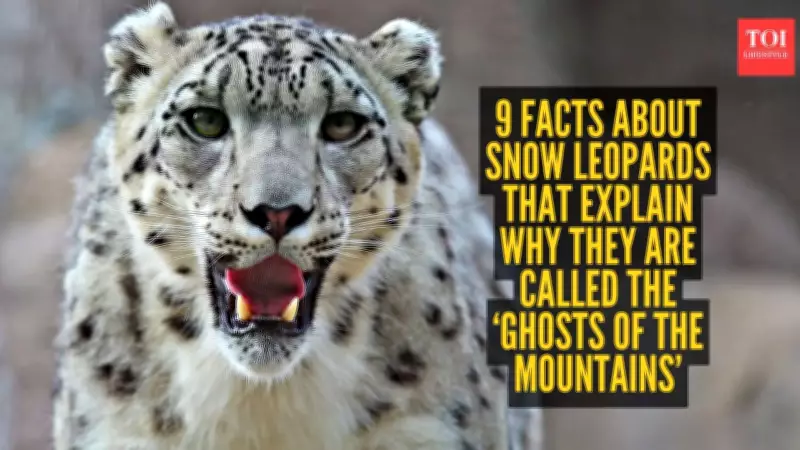
Snow leopards remain one of the most mysterious animals on Earth. While tigers and lions frequently appear in documentaries and social media, snow leopards are rarely seen. Their elusive nature and remote habitat make them seem almost mythical. Here are nine facts that explain why they are called the 'ghosts of the mountains.'
1. The 'Ghost of the Mountains' Nickname
This nickname is well-earned. Snow leopards have greyish-white fur that blends seamlessly with rocky, snow-covered terrain. Even experienced wildlife trackers can spend days searching for a single individual without success.
2. They Cannot Roar
Unlike lions and tigers, snow leopards cannot roar. Instead, they communicate through growls, hisses, yowls, and chuffing—a softer vocalization. Their quiet voice contrasts with their powerful appearance.

3. Remarkably Long Tails
A snow leopard's tail is thick, fluffy, and extremely long relative to its body. It aids balance while climbing steep cliffs and jumping across gaps. During cold weather, they wrap their tails around their faces for warmth.
4. High-Altitude Habitat
Snow leopards live in remote Himalayan and Central Asian mountains at elevations up to 6,000 meters. In India, they are found in Ladakh, Himachal Pradesh, and other parts of the Himalayan belt. They thrive where oxygen is low and temperatures are harsh.
5. Impressive Jumping Ability
These cats are powerful hunters capable of leaping distances several times their body length. This ability helps them navigate treacherous rocky terrain with speed and precision.
6. Fur-Covered Paws for Snow
Their large, fur-covered paws act like natural snowshoes, distributing weight to prevent sinking. The fur also insulates against icy surfaces, allowing them to move silently and efficiently.
7. Solitary Lifestyle
Snow leopards are solitary animals, unlike lions that live in prides. They roam vast territories alone, interacting only during mating season or when raising cubs. This behavior further reduces sightings.
8. Dawn and Dusk Activity
They are most active during dawn and dusk, known as crepuscular behavior. This timing helps them stay hidden and improves hunting success in changing light conditions.
9. Extremely Thick Fur
To survive freezing temperatures, snow leopards possess one of the thickest coats among big cats. Their dense fur provides essential insulation in their cold, mountainous environment.
These adaptations make snow leopards perfectly suited to their harsh habitat, but also incredibly difficult to observe. Their secretive nature and remote home ensure they remain one of the world's most enigmatic big cats.