

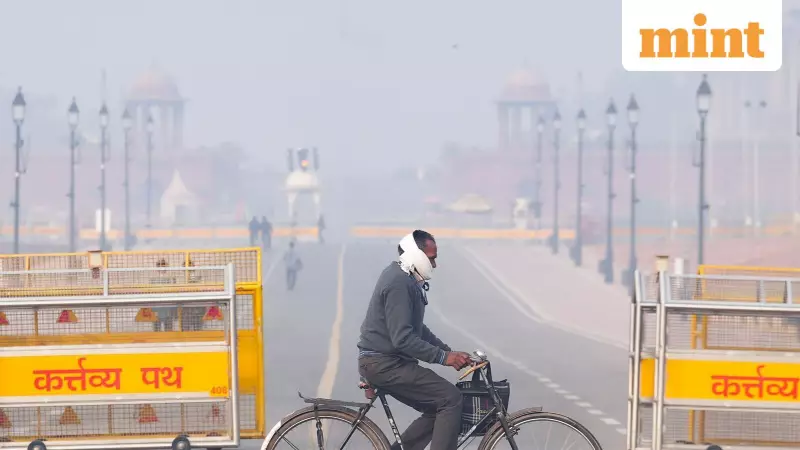
India faces a severe air pollution crisis, with 74 of the world's 100 most polluted cities located within its borders, according to the 2024 World Air Quality Report by IQAir. In the midst of this public health emergency, a small Pune-based climate-tech startup, Respirer Living Sciences, is making an outsized impact by changing how the country sees and understands its polluted air.
The Moving Labs and Hyperlocal Networks
The reality of India's air quality problem hit home for IntrCity SmartBus when it first measured the air inside its long-distance coaches. Despite sealed, air-conditioned cabins, PM2.5 levels were found to be five to six times higher than the World Health Organization's safe limits. Fine particulate matter seeped in as buses traversed industrial belts and construction corridors.
The company turned to Respirer Living Sciences for a solution. Today, each IntrCity SmartBus functions as a moving air-quality laboratory. Fitted with calibrated sensors, they track PM2.5, AQI, carbon dioxide, temperature, and humidity inside the cabin while simultaneously sensing outdoor air quality. This data feeds into an analytics platform that automatically controls filtration to maintain safe limits. On screens within the buses and the IntrCity app, passengers can see real-time air quality readings.

This is just one application of Respirer's core work. The startup builds and operates hyperlocal air-quality monitoring systems that measure pollutants at the street and neighbourhood level in real time. With a network of over 2,500 sensors across more than 40 Indian cities, it has created one of the country's largest independent monitoring networks.
This dense, street-level data reveals critical patterns that broader government stations often miss: pollution spikes in school zones at 8 am, unmonitored industrial clusters, and neighbourhoods where air quality deteriorates dramatically within a few hundred metres.
From an Idea to an Indispensable Asset
The founder, Ronak Sutaria, an engineer, did not initially set out to build an air-quality company. The idea germinated over a decade, influenced by his work on low-power sensor networks during his master's degree in the US and his observations of early environmental monitoring experiments in California.
After returning to India in 2010, Sutaria spent years exploring the potential for large-scale sensing networks. A pivotal moment came in 2014 through an interaction with the data journalism organization IndiaSpend. This led him to realize technology could generate evidence to inform public discourse and policy.
By 2015, he joined IndiaSpend as chief technology officer and helped build India's first independent air-quality monitoring network, deploying around 50 devices. This network provided the hyperlocal data used to evaluate Delhi's landmark odd-even traffic rationing policy in 2016.
To build a more robust and scientifically rigorous system, Sutaria spun off the air-quality work into a separate company in April 2017, giving birth to Respirer Living Sciences. The startup received its first funding from the Shakti Sustainable Energy Foundation and later secured grants from the Department of Science and Technology and partnerships with IIT Kanpur and CEPT University.
Mechanics, Business, and Challenges
Respirer's system involves a complex process of turning raw air samples into reliable data. The company designs its own monitoring devices in Pune, integrating imported laser-based sensors for particulate matter and electrochemical sensors for toxic gases. Data is streamed continuously to an online platform, where a dedicated team uses statistical models to correct for errors and improve accuracy.
The startup operates on a flexible hardware-plus-software model. Devices range from ₹30,000-35,000 for basic PM monitoring to ₹2.5-3 lakh for units with multiple gas sensors. Customers can also rent equipment for around ₹5,000 a month.
Respirer has developed three core revenue streams: industrial and occupational safety monitoring; government-led city or state air-quality networks; and clean-air mitigation solutions for enclosed spaces like buses and schools. Its customer base has expanded from 30-40 users two years ago to about 600 today, including major clients like Godrej and the Sanghvi Group.

The journey hasn't been without resistance. In 2019, the startup faced significant pushback from government agencies cautious about new sensor-based monitoring and public data dissemination. While this resistance has eased, challenges remain, including the recurring cost of replacing gas sensors every 18 months and scaling networks beyond major metros.
The Road Ahead for Clean Air Data
For now, Respirer remains a business-to-business company, acting as a back-end infrastructure provider. Founder Ronak Sutaria notes that publicly publishing hyperlocal data comes with regulatory and political complexities, often leading to confrontations with local authorities.
However, experts believe such hyperlocal sensing systems will eventually become as routine as CCTV cameras. As sensors become more affordable and reliable, these networks will be indispensable for smart-city governance, climate targets, and public health protection.
Mike Bergin, a professor at Duke University who has worked with sensor networks globally, emphasizes the power of this data. "Putting information, in this case air quality data, into people's hands really excites and empowers them. It makes us feel like we own the problem and need to figure out how to solve it," he said.
In a country where the average PM2.5 concentration in 2024 was 50.6 micrograms per cubic metre—ten times the WHO guideline—the work of startups like Respirer Living Sciences is not just innovative; it is critical for building the evidence-based backbone needed to clear the air.





