

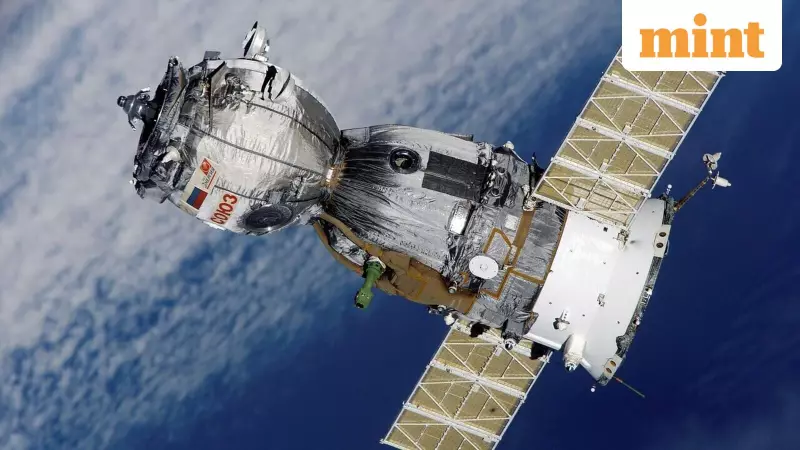
As Elon Musk's Starlink satellite internet service secures its final approval to launch in India, a pressing and potentially catastrophic issue comes to the fore: the unsustainable congestion in Earth's orbit. Scientists are raising alarms that the current situation in space resembles a fragile 'house of cards,' where a single major solar storm could trigger a disastrous chain reaction of collisions known as the Kessler Syndrome.
The Tipping Point: Solar Storms and the Kessler Threat
Researchers from Princeton University have identified solar storms as a potential tipping point that could turn the theoretical Kessler Syndrome into a grim reality. These storms from the Sun heat the Earth's atmosphere, increasing atmospheric drag. This forces satellites to burn significantly more fuel just to maintain their orbit and execute critical collision avoidance maneuvers.
The team pointed to the "Gannon Storm" of May 2024 as a recent example. This event compelled over half of all satellites in low Earth orbit to expend precious fuel reserves for repositioning. Beyond fuel concerns, solar storms can also damage satellite communication and navigation systems, blinding them and dramatically increasing the risk of catastrophic orbital collisions.

The Alarming CRASH Clock and Rising Collision Risks
To quantify this growing danger, researchers have developed a new metric called the CRASH (Collision Realization and Significant Harm) Clock. This clock estimates the time window within which a major collision could occur if a solar storm disables all satellite operators' ability to communicate and perform evasive maneuvers.
The findings are startling. Calculations show the CRASH Clock has plummeted to just 2.8 days. For perspective, it stood at 121 days in 2018. This dramatic reduction is directly linked to the rapid deployment of mega-constellations, primarily SpaceX's Starlink, which began its massive launch campaign in 2019.
Supporting this alarming trend, a 2023 filing by the US Federal Communications Commission (FCC) revealed that Starlink satellites alone were forced to make approximately 50,000 collision avoidance maneuvers in a recent four-year period. Professor Hugh Lewis, an astrophysicist at the University of Southampton, projects this number could soar to a million maneuvers every six months by 2028.
A Fragile Orbit and the Stakes for India
With the margin for error shrinking daily, the space environment is becoming increasingly precarious. If the Kessler Syndrome were to occur, it would not just threaten individual satellites; it could render entire orbital pathways unusable. The result could be a complete stoppage of launching new spacecraft, as the probability of collision with cascading space debris would become intolerably high.
For India, a nation aggressively expanding its own space ambitions and now welcoming global players like Starlink, this crisis presents a dual challenge. While new satellite services promise enhanced connectivity, they also contribute to the orbital traffic jam. The situation demands urgent international cooperation on space traffic management and sustainable practices to prevent Earth's orbit from becoming a junkyard that traps humanity on the planet.
The pre-print research paper detailing the CRASH Clock metric is available on arxiv.org, underscoring the scientific community's growing concern. As Starlink prepares for its Indian debut, the conversation must expand beyond pricing and coverage to include the long-term sustainability of the final frontier we all depend on.






