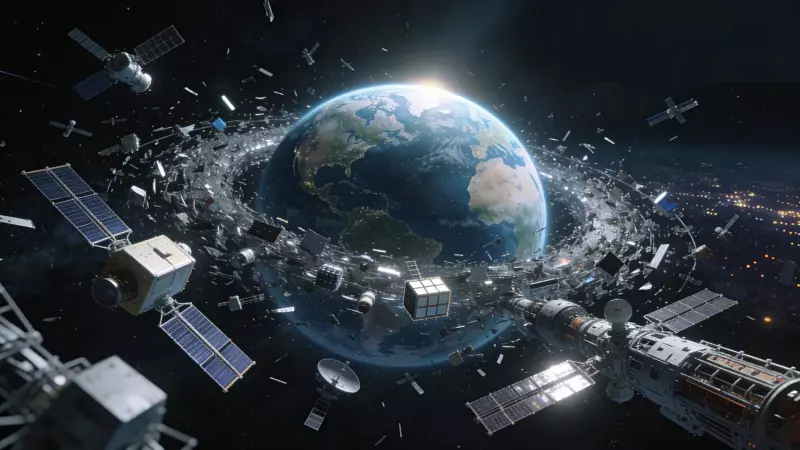
A startling new study has issued a grave warning: Earth's rapidly growing fleet of satellites is living on borrowed time, with the window to prevent a catastrophic chain reaction of collisions now dangerously narrow. Researchers state that a powerful solar storm could leave operators with less than three days to regain control before the probability of a major, cascading impact becomes unacceptably high.
The Ticking CRASH Clock: A Measure of Orbital Peril
At the core of this alarming assessment is a new metric developed by scientists, dubbed the "CRASH Clock" (Collision Realisation and Significant Harm). This clock does not predict the full-scale, long-term Kessler syndrome but estimates how quickly things could unravel if the systems preventing collisions were to fail. The findings, published on the arXiv preprint repository on December 10, 2025, are stark.
The CRASH Clock currently stands at just 2.8 days. This suggests that in the event of a widespread disruptive event—like a severe solar storm that disables satellite electronics and tracking—humanity would have under 72 hours to restore collision-avoidance capabilities before the risk of a catastrophic collision spikes. This marks a dramatic and worrying decline from the pre-megaconstellation era; in 2018, the same clock was calculated at a far more comfortable 121 days.

Crowded Skies: The Rise of Megaconstellations
The primary driver of this increased risk is the explosive growth in the number of active satellites, predominantly from large commercial networks. The orbital environment has transformed in recent years.
By 2024, over 14,000 satellites were orbiting Earth, with megaconstellations making up the majority. A single company, SpaceX, has been a major contributor to this congestion. Its Starlink network alone had deployed 8,811 satellites by October 2025. While these constellations provide vital global connectivity, they have turned key orbital lanes into high-traffic zones, drastically increasing the frequency of close approaches.
Researchers emphasize that the absence of major collisions to date is not due to empty space but because of continuous, precise avoidance manoeuvres. Satellites in low Earth orbit complete a revolution roughly every 90 minutes, constantly crossing paths. This dance is carefully choreographed by ground control. If that coordination were lost, the consequences would be swift.
Consequences of a Single Collision
The study outlines a grim domino effect that could follow a single significant impact. Within 24 hours of avoidance systems failing, there would be a 30% chance of a collision between two tracked objects and a 26% chance of a collision involving a Starlink satellite.
Any such collision would generate a cloud of high-speed debris. These fragments could then strike other satellites, creating more debris in a cascading chain reaction—a scenario first proposed in 1978 known as the Kessler syndrome. While a full-scale syndrome might take longer to develop, even one major collision could render certain orbital regions hazardous for decades, severely impacting future space activities and satellite services.
The researchers compare the situation not to an instant, cinematic shutdown but to a slow-moving environmental disaster, akin to a massive oil spill in space. Navigation, communication, weather forecasting, and countless other services that modern society depends on would operate under permanently riskier and more degraded conditions.
The study serves as a urgent call to action. It underscores that as our reliance on flawless satellite performance deepens, so does our vulnerability. The authors argue for better tools and strategies to manage the stress on Earth's orbital environment before a solar storm or systemic failure turns our crowded sky into a long-term hazard for all.