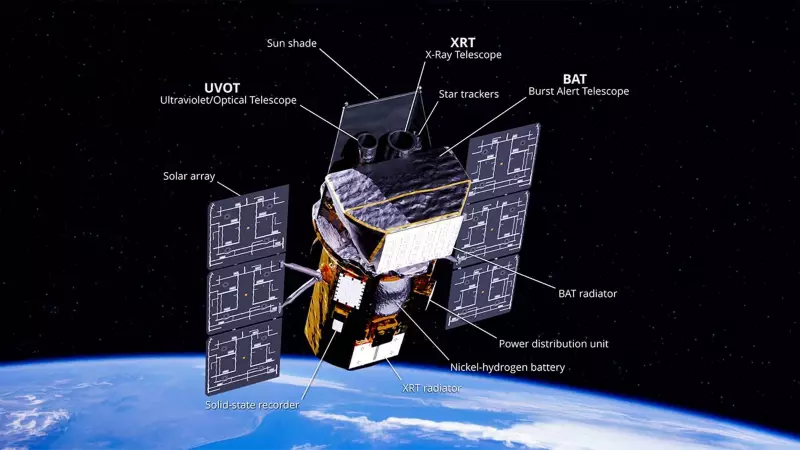
In a groundbreaking space rescue operation, NASA has commissioned an Arizona-based aerospace startup to save its aging Neil Gehrels Swift Observatory from uncontrolled re-entry into Earth's atmosphere. The $30 million mission aims to boost the satellite's orbit and extend its scientific operations beyond 2026.
The Descending Observatory
The Neil Gehrels Swift Observatory, launched in 2004 to study gamma-ray bursts - some of the most powerful explosions in the universe - has been gradually losing altitude in its low-Earth orbit. Recent increases in solar activity have accelerated this orbital decay, creating a 90 percent likelihood of uncontrolled re-entry by late 2026 if no intervention occurs.
While the satellite would likely disintegrate during re-entry and pose no threat to people or property on Earth, NASA and its partner Katalyst Space Technologies aim to preserve this extremely valuable research asset. The observatory has provided crucial scientific data about cosmic explosions and high-energy phenomena for nearly two decades.

The Rescue Strategy
Flagstaff-based Katalyst Space Technologies has been awarded $30 million by NASA to execute this ambitious rescue mission. The company is building a specialized spacecraft called LINK, designed to autonomously rendezvous with Swift and reposition it into a more stable orbit.
Under the tight contract terms, Katalyst has less than eight months to launch LINK and perform the rescue operation, with a target deadline of June 2026. The mission will utilize Northrop Grumman's Pegasus XL rocket, which will be air-launched from a carrier aircraft at approximately 39,000 feet (12,000 meters).
Technical Challenges and Solutions
The rescue mission faces several significant technical challenges. Swift's orbit is inclined at about 20.6 degrees - a deliberate choice made during its original launch to avoid the South Atlantic Anomaly, a region of weak magnetic field that increases radiation risk to spacecraft.
Kieran Wilson, Katalyst's Vice President of Technology, explained that reaching this specific orbital inclination from conventional ground-based launch sites would require substantial fuel. However, the Pegasus rocket's unique air-launch capability helps mitigate this constraint, making it ideally suited for this time-sensitive and cost-constrained mission.
Perhaps the most complex aspect involves the actual capture mechanism. Since Swift was not designed for servicing, it lacks docking ports or grappling fixtures. The LINK spacecraft will employ a custom robotic capture system to safely attach itself to the observatory before performing the crucial orbital boost.
This mission represents a potential game-changer for managing aging satellites in low-Earth orbit. If successful, it will demonstrate NASA's new capacity for satellite rescue and life extension, potentially saving billions of dollars in scientific assets and reducing space debris.