

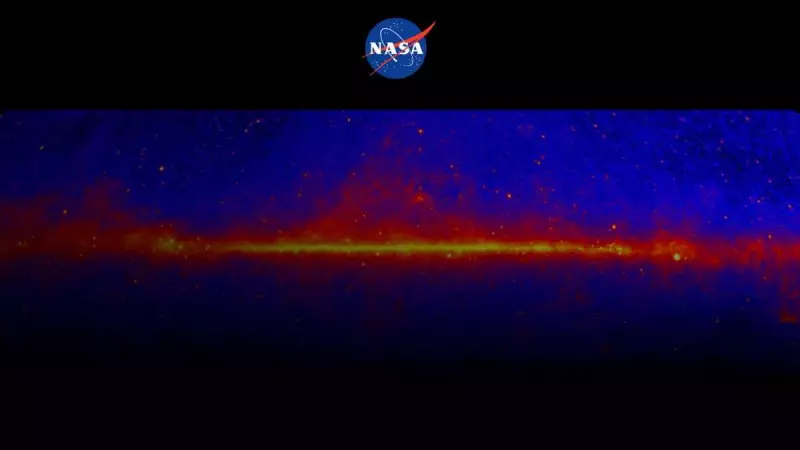
In a development that could rewrite physics textbooks, scientists analyzing data from NASA's Fermi Gamma-ray Space Telescope may have achieved what was once thought impossible: detecting dark matter for the very first time. The potential breakthrough, announced in late 2025, centers around an unusual gamma-ray signal that cannot be explained by conventional astrophysical sources.
The Elusive Cosmic Puzzle
For decades, dark matter has remained one of the greatest mysteries in modern physics. This invisible substance is believed to constitute approximately 85% of all matter in the universe, yet it neither emits nor absorbs light, making it incredibly difficult to detect directly. Scientists have only inferred its existence through its gravitational effects on visible matter.
The recent analysis of Fermi telescope data has revealed a peculiar excess of gamma-ray photons with a specific energy of 3.5 gigaelectronvolts (GeV) coming from dwarf spheroidal galaxies. These small, dim galaxies orbiting the Milky Way are considered ideal laboratories for dark matter searches because they contain very little ordinary matter and have high concentrations of dark matter.

The Fermi Telescope's Crucial Role
NASA's Fermi Gamma-ray Space Telescope, launched in 2008, has been instrumental in this potential discovery. The space observatory is designed to study the universe in gamma-ray wavelengths, the most energetic form of electromagnetic radiation. Over its 17 years of operation, Fermi has collected an enormous dataset that researchers have been meticulously analyzing for signs of dark matter annihilation or decay.
The key finding involves gamma rays at precisely 3.5 GeV energy, which could potentially be produced when hypothetical dark matter particles called Weakly Interacting Massive Particles (WIMPs) collide and annihilate each other. This signature matches theoretical predictions for certain types of dark matter particles.
Scientific Significance and Next Steps
If confirmed, this detection would represent one of the most significant astrophysical discoveries of the 21st century. Dark matter detection has been a holy grail for physicists worldwide, and this finding could finally provide direct evidence for the existence of this mysterious cosmic component that has eluded scientists for nearly a century.
The research team emphasizes that while the signal is compelling, further verification is necessary. Scientists plan to conduct additional observations and analyses to rule out alternative explanations, such as unknown astrophysical sources or instrumental effects. The international scientific community has already begun independent assessments of the data.
This potential breakthrough demonstrates the importance of long-term space missions and persistent data analysis. The Fermi telescope continues to operate beyond its original mission timeline, proving that sustained investment in scientific infrastructure can yield revolutionary results years or even decades after deployment.
The discovery also highlights the growing sophistication of data analysis techniques in astrophysics. Researchers combined observations from multiple dwarf galaxies to enhance the statistical significance of their findings, a method that has become increasingly powerful as telescope datasets grow larger over time.






