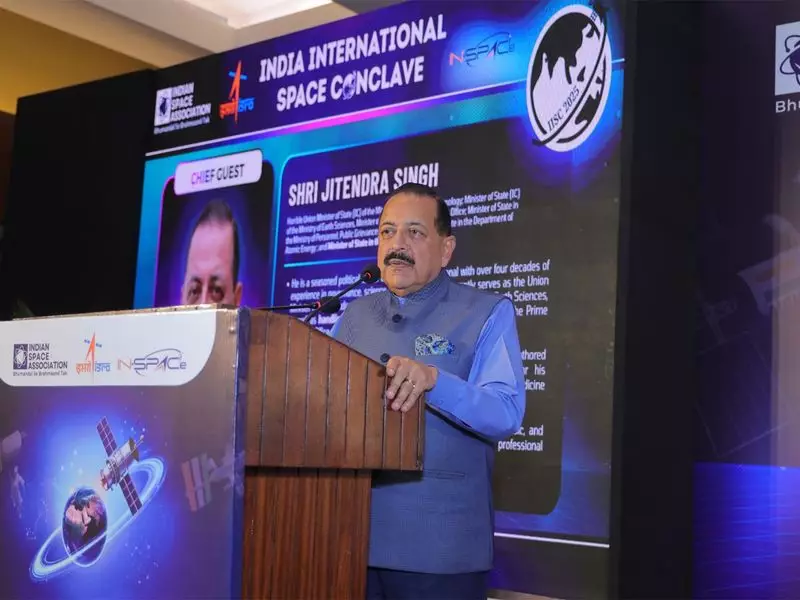
India's space sector is poised for unprecedented growth and is expected to become a significant contributor to the nation's economy, with projections indicating the industry could reach $44 to $45 billion within the next decade. This optimistic forecast was shared by Union Minister of State for Science and Technology, Jitendra Singh, who highlighted the transformative potential of recent policy reforms and technological advancements.
Historic Policy Reforms Driving Growth
During a high-level meeting in New Delhi, Dr. Jitendra Singh revealed that India's space economy currently stands at approximately $8 billion, representing just about 2% of the global space economy. However, with strategic interventions and policy reforms initiated under Prime Minister Narendra Modi's leadership, this figure is expected to multiply dramatically.
The minister emphasized that the opening up of the space sector to private participation has been a game-changer. Over 500 private startups have registered with the Indian National Space Promotion and Authorisation Centre (IN-SPACe), demonstrating the vibrant entrepreneurial interest in this domain. This represents a significant shift from the previous scenario where the space sector was predominantly government-driven through ISRO.

From 2% to Global Leadership
Dr. Singh pointed out that while India currently contributes about 2% to the global space economy, the country possesses the potential and capability to capture a much larger share of the international market. The ambitious target of reaching $44-45 billion would represent substantial growth and position India as a major player in the global space industry.
The minister credited the success of recent missions like Chandrayaan-3 and Aditya L1 for generating renewed interest and confidence in India's space capabilities. These achievements have not only demonstrated technological prowess but have also showcased India's cost-effective approach to space exploration, making the country an attractive partner for international collaborations.
Employment Generation and Economic Impact
Beyond the direct economic contributions, the expansion of the space sector is expected to generate significant employment opportunities across various skill levels. From highly specialized scientists and engineers to technical support staff and manufacturing personnel, the growing industry will create numerous job opportunities for India's youth.
The space sector's growth will have multiplier effects on related industries including telecommunications, agriculture, urban planning, disaster management, and climate monitoring. The development of indigenous capabilities in satellite manufacturing, launch services, and space applications will reduce dependency on foreign technologies and create export opportunities.
Dr. Singh also highlighted that the space sector reforms align with the government's vision of making India a developed nation by 2047. The integration of space technology with other sectors of the economy will enhance efficiency, improve governance, and create new business models that leverage space-based assets and data.