

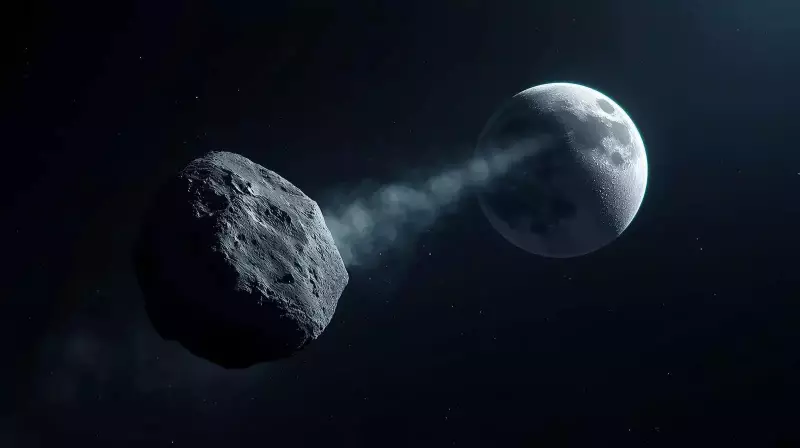
Astronomers across the globe are tracking a significant piece of space debris with heightened vigilance as they evaluate a rare but potentially dramatic scenario. The asteroid, named 2024 YR4 and measuring approximately 60 metres in length, has a calculated possibility of colliding with the Moon on 22 December 2032. Such an event, due to its enormous force, could create an impact flash visible from Earth with telescopes, and potentially even to the naked eye under ideal conditions.
While researchers stress that the probability remains low, the potential consequences extend far beyond merely creating a new crater on the lunar surface. A collision of this magnitude could propel a cloud of fast-moving debris into space, posing a genuine threat to satellites in Earth's vicinity and future human missions. The scientific community is relying on advanced observatories, including the James Webb Space Telescope (JWST), to provide crucial data in the coming years.
What We Know About Asteroid 2024 YR4
Discovered in December 2024 during routine sky surveys for near-Earth objects, asteroid 2024 YR4 initially raised minimal concern for our planet. Further precise computations completely ruled out an impact with Earth, shifting scientific focus to its lunar trajectory. Despite being comparable in size to a small building, a 60-metre space rock carries immense kinetic energy. This makes it a subject of serious study, especially given the increasing congestion in Earth orbit with satellites and planned crewed missions to the Moon.

Potential Impact Details and Risks
At a recent American Geophysical Union meeting, scientist Patrick King from Johns Hopkins University Applied Physics Laboratory presented findings indicating a roughly 4% chance of a direct lunar strike. Simulations suggest that if an impact occurs, there is an 86% probability it would happen on the Moon's near side—the hemisphere permanently facing Earth. This significantly increases the likelihood of observation from locations like Hawaii and parts of the western United States, weather permitting.
The energy release from such a collision would be staggering, equivalent to about six million metric tonnes of TNT—roughly 400 times more powerful than the Hiroshima atomic bomb. While the Moon would remain intact, the primary concern lies in the aftermath. The impact could eject lunar and asteroid fragments at high velocities, creating a hazardous debris field.
The main risks identified by scientists are twofold:
- Satellite Damage: Even small, fast-moving particles could cripple or shorten the lifespan of satellites in critical orbits.
- Threat to Astronauts: Future crewed missions to the Moon and cislunar space would face an elevated risk from such unpredictable debris, with experts urging that even a 1% chance of debris reaching key orbits is taken seriously.
The Crucial Role of the James Webb Space Telescope
The next major step in understanding this threat will come in February 2026, when the James Webb Space Telescope is scheduled for detailed observations of 2024 YR4. JWST's powerful instruments are expected to refine measurements of the asteroid's size, shape, and most importantly, its exact orbit. Previous observations in March 2025 helped eliminate an Earth impact scenario. The 2026 data could either solidify the lunar impact prediction or dismiss it entirely. A failure in these observations would leave scientists with greater uncertainty, complicating long-term planning and risk assessment.
Why This Close Watch Matters
This event underscores the dynamic and sometimes unpredictable nature of our solar system. Observing a fresh impact of this scale would be a scientific goldmine, offering unprecedented insights into impact physics, crater formation, and the behaviour of ejected material in space. Regardless of the outcome—a spectacular lunar collision or a quiet flyby—the tracking of 2024 YR4 serves as a potent reminder of the need for constant sky surveillance and global cooperation in planetary defence. The knowledge gained will be invaluable for protecting both Earth and humanity's growing footprint in space.






