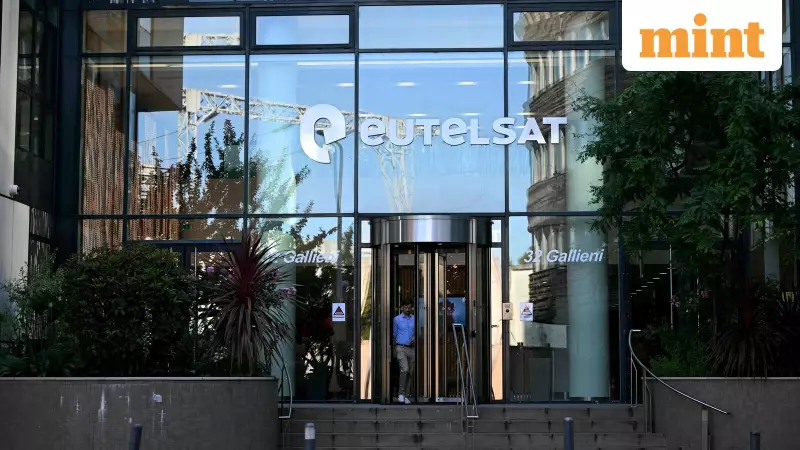
Satellite Internet's True Value Lies in National Benefits, Not Government Revenue
In a significant development for India's emerging space communications sector, Eutelsat OneWeb, backed by Bharti Enterprises, has presented a compelling case about the fundamental economic value of satellite communication services. During the India International Space Conclave in New Delhi on Tuesday, company executives emphasized that the real worth of satcom extends far beyond immediate government revenue from licensing or spectrum fees.
Neha Idnani, Regional Vice-President for Asia-Pacific at Eutelsat OneWeb, articulated this perspective clearly: "Regulators, whether in India or globally, need to see that the economic value of satcom is not going to come from the likes of spectrum monetisation or licence fees. It is really going to come from digital inclusion."
Spectrum Pricing Debate Intensifies
These comments arrive at a crucial juncture as the Indian government finalizes its spectrum allocation strategy and pricing structure for satellite internet providers. Recent developments indicate ongoing discussions between regulatory bodies, with the Department of Telecommunications (DoT) recently requesting the Telecom Regulatory Authority of India to reconsider certain recommendations regarding satellite spectrum assignment.

According to a November 17 Mint report, the DoT has proposed an annual spectrum charge of 5% instead of the 4% initially recommended by Trai. The department is also considering providing a 1% discount on spectrum charges for operators who successfully enroll at least 5% of their annual customers from hard-to-reach regions, including border areas, hills, and islands.
Under current authorization terms, satellite companies will be required to pay spectrum charges calculated from their adjusted gross revenue (AGR) alongside an annual license fee amounting to 8% of their AGR.
Complementary Role in India's Connectivity Ecosystem
Addressing concerns about potential competition between satellite and terrestrial networks, Idnani clarified that satellite internet is designed to complement existing telecom infrastructure rather than disrupt or compete with it. "Yes, there needs to be a level playing field but that is when satcom is getting into the turf of terrestrial. Today, we as a service provider strongly believe that we need to go and serve those places where terrestrial communication is either technically or commercially not viable as a primary mode of communication," she explained.
Idnani further emphasized that satellite communication provides resilient backup infrastructure to India's telecom networks, significantly enhancing the nation's digital resilience and adding substantial economic value to the overall connectivity framework.
The satellite internet landscape in India is becoming increasingly competitive, with major players including Starlink, Eutelsat OneWeb, Jio Satellite, and Amazon Leo (formerly Kuiper) preparing to launch services. Spectrum allocation remains the final significant hurdle before these services can commence operations, with both the telecom department and regulator actively working to resolve this critical issue.
Last month, Elon Musk's Starlink highlighted that a substantial portion of its Indian capacity would remain underutilized unless rural users subscribed to its upcoming services, indicating that these users are fundamental to their network operations. Meanwhile, traditional telecom operators have expressed concerns to the government about satellite internet services potentially capturing their urban market share, making the spectrum pricing discussion particularly contentious.
As India stands at the crossroads of a connectivity revolution, the debate continues between immediate government revenue through spectrum fees and the long-term national benefits of widespread digital inclusion through satellite technology.