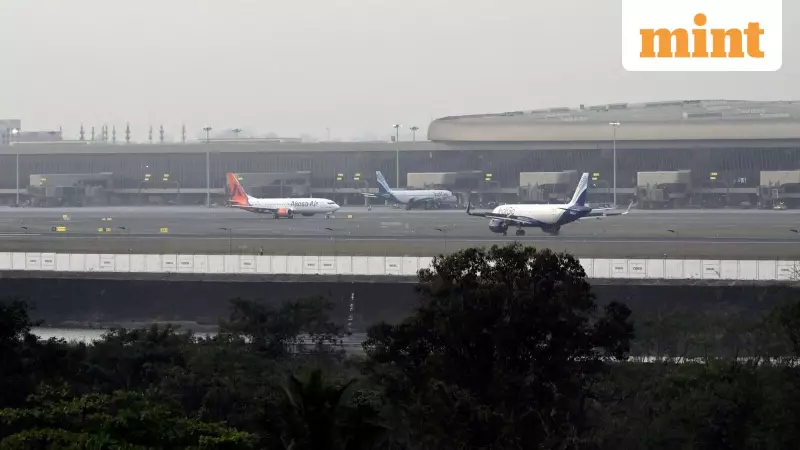
A major dispute has erupted between India's leading telecom service providers and the Adani Group over the rollout of mobile networks at the newly inaugurated Navi Mumbai International Airport (NMIA). Reliance Jio, Bharti Airtel, and Vodafone Idea have jointly raised concerns, alleging that the airport operator is blocking their infrastructure deployment and imposing exorbitant charges.
The Core of the Controversy: Right of Way Denied?
In a formal letter to Telecom Secretary Neeraj Mittal, the telecom operators, represented by the Cellular Operators Association of India (COAI), have accused Navi Mumbai International Airport Ltd (NMIAL) of denying them the necessary Right of Way (RoW) permissions. This legal framework is essential for installing telecom infrastructure like in-building solutions (IBS) for seamless 4G and 5G coverage. Instead of granting independent access, the operators claim NMIAL is forcing them to use a pre-installed network at commercially unviable rates.
The COAI's Director General, S.P. Kochhar, stated that NMIAL's actions contradict the statutory mandates of the Telecommunications Act, 2023, and the RoW Rules of 2024, which require non-discriminatory and time-bound access. The dispute has already impacted passengers, with many taking to social media to complain about poor cellular connectivity since the airport began commercial operations on 25 December 2024.

Exorbitant Charges and Legal Standoffs
The financial demand at the heart of this conflict is substantial. According to the COAI, NMIAL is seeking payments of approximately ₹92 lakh per month per operator. For the three private telcos and the state-owned BSNL, this aggregates to nearly ₹44.16 crore per annum. The operators argue this sum far exceeds the typical capital expenditure needed to deploy their own independent IBS networks.
Legal experts suggest the telecom companies have a strong case. Aurelia Menezes, a partner at King Stubb & Kasiva, noted that while neutral-host models are common globally, they must operate with fair access and pricing. "Any arrangement that effectively denies RoW or creates a monopolistic gatekeeper risks undermining both regulatory intent and consumer choice in India," Menezes explained.
Adani Airport's Defense and the Neutral-Host Argument
In response to the allegations, an NMIAL spokesperson denied outright refusal of RoW permissions. The airport authority defended its position by stating it has deployed a state-of-the-art, neutral-host mobile network to ensure uniform coverage, including in critical operational areas like baggage belts and air traffic control, which are often neglected by telcos focusing on passenger zones.
The spokesperson emphasized that the airport, being a highly sensitive zone, requires frequent maintenance and security-cleared personnel, which is best managed by the airport operator itself. They also mentioned that BSNL is already in an advanced testing phase for using the installed IBS and that discussions with other TSPs are ongoing. NMIAL holds a Virtual Network Operator (VNO) licence, allowing it to offer services without owning spectrum.
A Recurring Pattern and the Path Forward
This is not an isolated incident. In May 2024, a similar dispute occurred with the Mumbai Metro Rail Corporation Ltd (MMRCL). The current standoff highlights a growing tension between infrastructure owners and licensed telecom providers over control of in-premises connectivity.
The telecom operators have urgently requested the Department of Telecommunications (DoT) to direct NMIAL to grant RoW permissions in accordance with the law. They also want NMIAL to stop blaming them for the lack of network coverage, which they assert is a direct result of the denied permissions. As the Navi Mumbai airport aims to become a major aviation hub, the resolution of this conflict will set a significant precedent for telecom infrastructure access in India's future mega-projects.