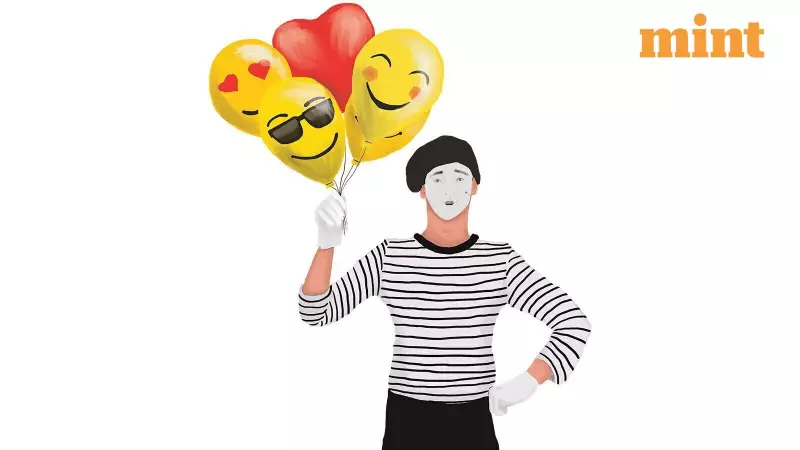
In today's digital landscape, words are gradually vanishing from our daily interactions. The familiar rhythm of friendship now follows a simple pattern: share a reel, respond with a reacji, and repeat. This transformation represents a fundamental shift in how people communicate across social platforms.
The New Language of Digital Friendship
Shantanu Anand, a 33-year-old Mumbai resident, maintains his friendships through what he calls "pebbling." Each evening, he checks his Instagram direct messages to view the reels friends have sent throughout the day. His response typically involves reacting with emoticons known as reacjis, forwarding some content to other friends, then moving on. This cycle defines most of his social interactions in the digital space.
This phenomenon isn't unique to Anand. Recently, Instagram's official broadcast channel highlighted a viral reel from @thefunfashionista that asked: "Are you even best friends if your chat doesn't look like this?" The video, which accumulated over half a million likes, displayed a conversation consisting entirely of reels and reacjis exchanged between two users. Noticeably absent from these exchanges were written words.

How Technology Reshapes Expression
The gradual disappearance of words from digital communication didn't happen overnight. Technology has systematically reduced our need for written expression, while generative AI further diminishes our ability to construct coherent sentences. The evolution began with SMS shorthand necessitated by character limits, progressed through Twitter's emphasis on brevity, and has now reached a point where visual content takes precedence across all platforms.
Vikrama Dhiman, who works in product management at a consumer internet company in Singapore, explains the rationale behind this shift. "The more effort users must expend, the less time they spend on an application. That's why every platform optimizes for reduced text input."
This optimization isn't entirely new. Twitter introduced the retweet button in 2009, eliminating the need to manually type "RT" or "QT" when sharing content. Facebook's "Like" button similarly transformed engagement on that platform. Today, food delivery applications allow customers to reorder from frequently visited restaurants without typing a single word.
Padmini Ray Murray, founder of Design Beku, a digital rights consultancy in Bengaluru, offers additional perspective. "Designers build for scale, and in countries like India, they must consider large sections of low-literacy users, which explains some of this optimization."
The Neurological Impact of Visual Communication
Mumbai-based neurologist Siddharth Warrier provides scientific insight into how this shift affects our brains. "Language represents a dual-sided phenomenon," he explains. The brain's left side connects words to meaning, while the right side helps formulate coherent sentences. Within this system, the Wernicke area handles comprehension, while Broca's area manages expression.
Warrier emphasizes that memory strengthens through use. When we read, the words we absorb get reused when we speak or write, reinforcing recall. Visual content behaves differently—it's easily consumed but difficult to express because we must convert what we see into language.
"We never wrote letters to each other unlike our elders, and we're worse for it," Warrier observes. "Letters compelled people to sit with their feelings. My generation matured with texts, and the next is growing up with emojis."
The neurologist notes that while emojis and reaction tools make communication faster, they remove the friction that deepens self-understanding. "Words require work—they're not easy. The process of articulating emotions through words provides greater insight to regulate and analyze them."
Educational and Social Consequences
In Mumbai's ICSE schools, English teacher Shreya Bhagattjee witnesses the effects of this transition firsthand. Having taught English, mass communication, and geography to grades IX through XII for nearly ten years, she observes that compared to five years ago, students struggle more with writing coherent sentences and essays.

What surprises Bhagattjee isn't just the decline in writing skills but students' growing preoccupation with mastering artificial intelligence. Children explicitly express interest in learning how to use AI to their advantage and how to frame prompts that generate desired answers.
Anshuma Kshetrapal, a Delhi-based creative arts psychotherapist, comments on the emotional implications. "AI can be useful when you want to remove emotion from communication. But when articulating feelings, I condemn its use because it eliminates the 'I' from conversation. There's no personal nuance, no opportunity for self-reflection."
Kshetrapal argues that conflict resolution and emotional clarity were never skills learned through rote instruction. "You must undergo the rigor of experiencing conflict, understanding how words create impact, and observing how situations resolve themselves." In an era of low-effort, minimal-text conversations, she worries that "the muscle will simply atrophy, particularly for people maturing during these times because so little infrastructure exists to learn it."
Resistance and Adaptation
Some individuals are pushing back against this trend. Aashna J, a 26-year-old Mumbai entrepreneur, heavily relied on emoji shorthand with close friends during college. However, geographical separation changed her perspective. "Now that I live in a different city and country from most close friends, words have become extremely important to me," she shares.
To maintain meaningful connections, she recently started a Substack newsletter, providing detailed updates in complete sentences about her life. She's reconsidered what constitutes genuine online engagement. "I previously posted heart-eyes or fire emojis on friends' photos, but I've realized that's essentially meaningless. An emoji represents the lowest form of effort. Now I write proper sentences, which genuinely makes people feel you're thinking about them."
Others preserve older communication rituals. Minari Shah, a Mumbai-based communications consultant in her fifties, still writes and sends handwritten letters for special occasions. "Invariably, I hear how people treasure those," she notes.
Warrier finds such practices encouraging. The brain adapts to whatever it repeatedly practices, he explains. Studies demonstrate that written communication activates more neural networks to unpack meaning. Visual communication transfers information easily but sacrifices depth. "There's always a trade-off between ease and complexity," he concludes.