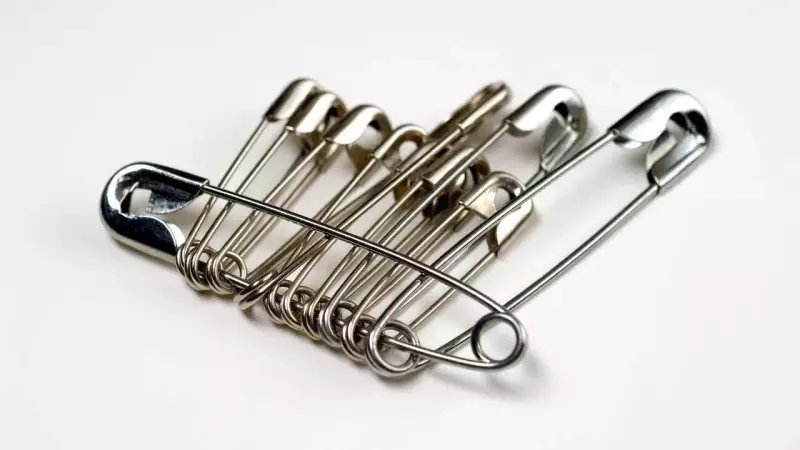
In every household, hospital, and workshop across India and the world, a humble hero lies unnoticed: the safety pin. This simple fastener, a staple in our daily lives, holds a tiny secret—a circular hole at the end of its clasped arm. For over a century and a half, this feature has remained unchanged, surviving revolutions in materials and manufacturing. But why does it exist, and what purpose does it serve? The answer reveals a fascinating story of clever engineering, practical design, and historical persistence.
The Manufacturing Marvel: Why the Hole Exists
A safety pin is crafted from a single piece of wire, shaped through precise bending, coiling, and heat treatment. The iconic hole is not an afterthought but a direct result of the manufacturing process. When the wire is terminated at the clasp end, it is bent back on itself to form a closed loop, rather than being cut straight. This loop becomes the visible hole in the finished pin.
From a production standpoint, this loop is crucial. It creates a uniform, rounded end that prevents sharp wire edges from snagging fabric or skin. More importantly, it allows for fully automated forming. The wire can be easily guided and bent through fixed tooling in factories that produce thousands of pins per hour. In high-volume manufacturing, even tiny efficiencies in design translate into significant cost savings and lower defect rates. The hole, therefore, is a brilliant solution born from the demands of repeatable, large-scale production.

Engineering for Strength and Flexibility
Beyond the factory floor, the hole plays a critical role in the pin's performance. When fabric pulls against a closed safety pin, force travels along the shaft and concentrates at the clasp. If the end were a solid termination, stress would focus at a single sharp bend, making the metal prone to snapping. The looped hole spreads this stress over a rounded section of the wire, significantly reducing the risk of permanent deformation or breakage during repeated use.
Furthermore, the hole grants the clasped tip a small amount of rotational freedom relative to the shaft. This subtle movement allows the pin to align itself as fabric moves or stretches. As noted in an analysis by Reader's Digest, this flexibility is key to helping the pin maintain a secure closure on thicker or uneven materials. It's a minor feature with a major impact, enabling the pin to function reliably under varying loads without needing complex locks or extra parts.
A Legacy Locked in Time: From 1849 to Today
The modern safety pin is credited to American inventor Walter Hunt, who patented the design in 1849. His patent drawings clearly show a coiled spring at one end and a clasp with a looped termination at the other. Even in the mid-19th century, looped ends were a known metalworking technique for managing stress and improving safety in fasteners.
The persistence of the hole is a testament to continuity, not later improvement. Once a low-cost, effective design enters mass circulation, there is little incentive to change it. The hole does not hinder the pin's primary function and accommodates variations in size, wire gauge, and material. As production shifted from brass to steel and from small workshops to industrial plants, the loop remained compatible with existing tools and user habits. Its survival is a record of how a smart, incremental engineering decision becomes permanently locked in through repetition and utility.
Over time, this incidental feature has also found secondary uses that its creators may never have imagined. The hole can guide thread or elastic through a waistband, act as an anchor in craft projects, or even serve as a tiny hook for tags in medical and laboratory settings. It has transformed the safety pin into a hybrid tool—part fastener, part utility hook—all without a single change to its original design. The humble hole stands as a stable interface between object and user, shaped by the logic of metalworking and sustained by enduring practicality.