For years, a profound cosmic mystery has baffled astronomers: how did supermassive black holes, weighing billions of times our Sun, appear when the universe was a mere infant, just one billion years old? The conventional lifecycle of stars could not account for such rapid, colossal growth. Now, a groundbreaking discovery by the James Webb Space Telescope (JWST) has finally cracked the case, providing the first concrete evidence for the existence of theoretical 'monster stars' that acted as the seeds for these cosmic giants.
The Chemical Fingerprint of a Galactic Monster
The key breakthrough came from an in-depth analysis of a distant galaxy known as GS 3073. An international team of scientists from the University of Portsmouth and the Harvard-Smithsonian Center for Astrophysics focused their study on the galaxy's chemical composition. They made a startling observation: the ratio of nitrogen to oxygen in GS 3073 was measured at 0.46, a figure wildly disproportionate to what is produced by ordinary stars.
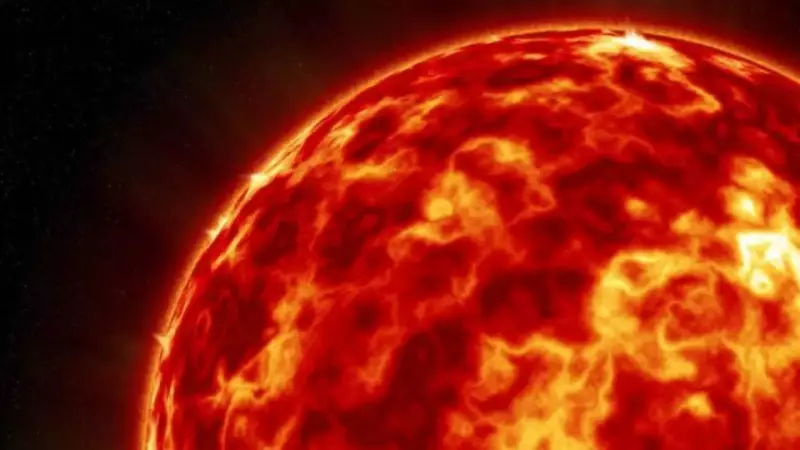
This abnormal chemical signature is the smoking gun. According to the researchers, such extreme nitrogen enrichment can only be explained by the past presence of primordial 'monster stars.' These behemoths are theorized to have been thousands of times more massive than our Sun. Unlike regular stars, they lived fast and died young, but in their brief, brilliant lives, they fundamentally altered their surroundings.

How Monster Stars Forged Nitrogen and Black Holes
The unique lifecycle of these colossal stars holds the explanation. With masses ranging from 1,000 to 10,000 times that of the Sun, they burned through their nuclear fuel at a ferocious rate. In their cores, helium fused to create carbon. This carbon was then transported to outer shells where hydrogen fusion was occurring.
Here, a powerful process called the carbon-nitrogen-oxygen (CNO) cycle took over. The interaction of carbon and hydrogen in this cycle produced vast amounts of nitrogen. Convection currents within the star then carried this nitrogen to the stellar surface, from where it was violently ejected into the surrounding interstellar medium, enriching the early galaxy with its distinctive chemical fingerprint.
Their dramatic end was equally consequential. Instead of culminating in a supernova explosion, these monster stars are believed to have undergone a direct gravitational collapse. At the end of their short lives, they simply imploded directly into black holes, funneling their enormous mass into a singularity without the explosive loss of material. This efficient process created the perfect 'seed' for a supermassive black hole to rapidly grow.
Illuminating the Cosmic Dark Ages
This discovery does more than solve a long-standing puzzle; it throws light on the universe's 'Dark Ages.' This refers to the first few hundred million years after the Big Bang when the first stars and galaxies began to form. The monster stars served as powerful cosmic catalysts, transforming the simple primordial soup of hydrogen and helium into chemically rich environments.
GS 3073 itself hosts an actively feeding supermassive black hole at its center, which researchers suggest could be the direct remnant of one such ultra-massive first star. This provides a direct link between the observed chemical anomaly and the presence of an ancient black hole, confirming theoretical models proposed as recently as 2022.
By identifying the chemical signatures left behind by these monster stars, scientists now have a powerful new tool. It allows them to trace the formation of the earliest structures in the universe and understand the rapid chemical evolution that paved the way for the galaxies we see today. The James Webb Space Telescope, by peering into this ancient past, has not just found an answer but has opened a new window into the dawn of cosmic time.