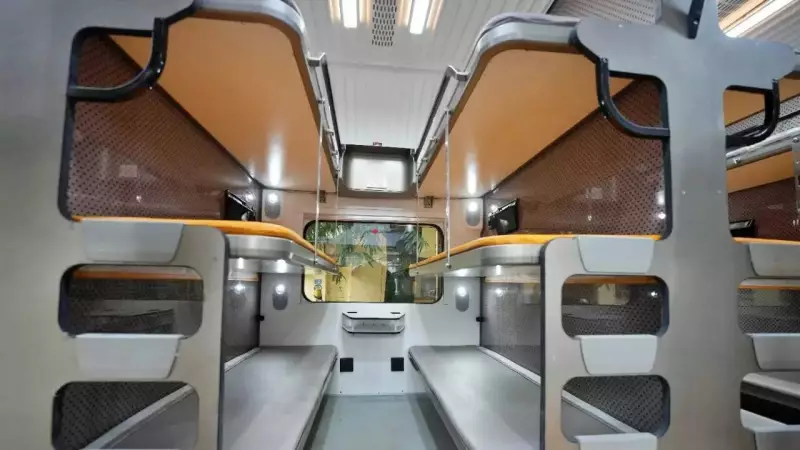
India's much-anticipated Vande Bharat sleeper train is inching closer to its official launch, having successfully completed a crucial high-speed trial. Railway Minister Ashwini Vaishnaw provided a significant update on Tuesday by sharing a video on the social media platform X (formerly Twitter) that captured the train's impressive performance.
Speed Trial Demonstrates Engineering Prowess
The highlight of the trial was the train achieving its maximum design speed of 180 kilometres per hour on the Kota-Nagda section of the Indian Railways network. However, what truly captured public imagination was a simple yet effective demonstration of the train's stability. A video clip showed glasses filled with water placed on a surface inside the moving train. Remarkably, not a single drop spilled even as the train hurtled at its top speed, proving the exceptional balance and smooth ride quality of the new generation rolling stock.
"Vande Bharat Sleeper tested today by Commissioner Railway Safety. It ran at 180 kmph between Kota Nagda section. And our own water test demonstrated the technological features of this new generation train," Minister Vaishnaw stated in his post.

Features and Manufacturing Ramp-Up
Designed for overnight, long-distance journeys, the Vande Bharat sleeper is the sleeper-class variant of the existing chair car Vande Bharat trains. Two prototype rakes of the fully air-conditioned train have been built by Bharat Earth Movers Limited (BEML) and are undergoing rigorous testing. Indian Railways is planning a massive transformation of long-distance travel, with an ambitious plan to introduce over 200 Vande Bharat sleeper trains in the coming years.
To meet this colossal demand, multiple manufacturing programs are running concurrently:
- BEML, in partnership with Integral Coach Factory (ICF), is producing 10 sleeper train sets.
- Another 10 sets are being developed by Kinet, a joint venture between Indian and Russian entities.
- A consortium of Titagarh Rail Systems and BHEL has secured a contract to manufacture 80 sleeper variants.
- ICF is also independently working on an in-house sleeper version of the Vande Bharat.
Passenger-Centric Design and Amenities
The first two prototypes consist of 16 coaches, configured with 11 AC three-tier coaches, four AC two-tier coaches, and one AC first-class coach. While tested at 180 kmph, it is designed as a semi-high-speed service operating at up to 160 kmph, with actual speeds contingent on track conditions across the network.
Drawing inspiration from European train design, the coaches promise enhanced passenger comfort with cushioned berths and redesigned, easier-to-climb access to upper berths. The amenity list is comprehensive:
- Advanced bio-vacuum toilets (similar to aircraft).
- Accessible toilets for persons with disabilities, baby care units, and shower cubicles with hot water in the AC First Class.
- Individual reading lamps, charging sockets, and foldable tables.
- Low-intensity night lighting, audio-visual passenger information systems, and CCTV surveillance.
- Modular pantry arrangements and fully sealed gangways for better air quality and temperature control.
Safety and Monitoring Systems
Safety is paramount, with the train equipped with the indigenous KAVACH anti-collision system. It also incorporates regenerative braking for energy efficiency, a feature carried over from the chair car version. A Centralised Coach Monitoring System will keep a watch on coach parameters, and an emergency communication facility will allow passengers to contact the locomotive driver directly if needed.
The successful speed trial marks a critical milestone, signalling that the launch of the Vande Bharat sleeper train, set to redefine overnight rail travel in India, is on the horizon.