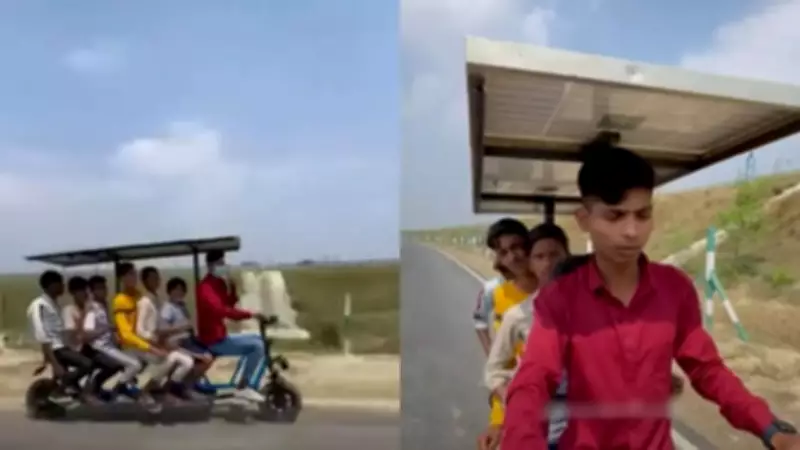
A 22-year-old man from Azamgarh, Uttar Pradesh, Asad Abdullah, has captured national attention by building a seven-seater vehicle that runs entirely on solar energy. His journey began in a small workshop with a pile of discarded metal and a simple idea. After numerous attempts and immense effort, he successfully created a vehicle that not only transports people but also saves fuel and energy.
The Solar-Powered Creation
Abdullah's vehicle, constructed from scrap materials, is reported to travel over 200 kilometers on solar energy, provided it is exposed to sunlight. According to Abdullah, the concept is straightforward: if there is sunlight, the vehicle runs smoothly without any fuel. His philosophy is that clean energy should be usable in everyday life, not locked away in expensive stores.
Cost-Effective Innovation
What surprises many is the cost of the invention. The entire build came together using scrap that cost him between Rs 8,000 and Rs 10,000, utilizing materials that most would discard as junk. Moreover, the vehicle can comfortably seat seven people, making it a practical and fruitful creation rather than just an experiment.

Social Media Reactions
The invention has sparked widespread appreciation on social media. One Instagram user wrote, "Fantastic..words are not enough to praise this boy and his invention." Another commented, "The youth of our country are beyond imagination. They rule other countries of the world, too. Hope they are encouraged and motivated. Salaam beta." However, some raised concerns about legality, with one user suggesting, "I don't know if this is legal. But the regulatory framework needs to change to allow such innovation on public roads."
Broader Implications
In a country like India, where fuel costs and pollution remain persistent challenges, Abdullah's model—though rough in its working—fuels important conversations about conservation. His work stands out not just for the machine itself, but for the belief that sustainability does not require big budgets or polished systems. Sometimes, the resources around us, such as scrap and sunlight, can be harnessed if we are willing to try.