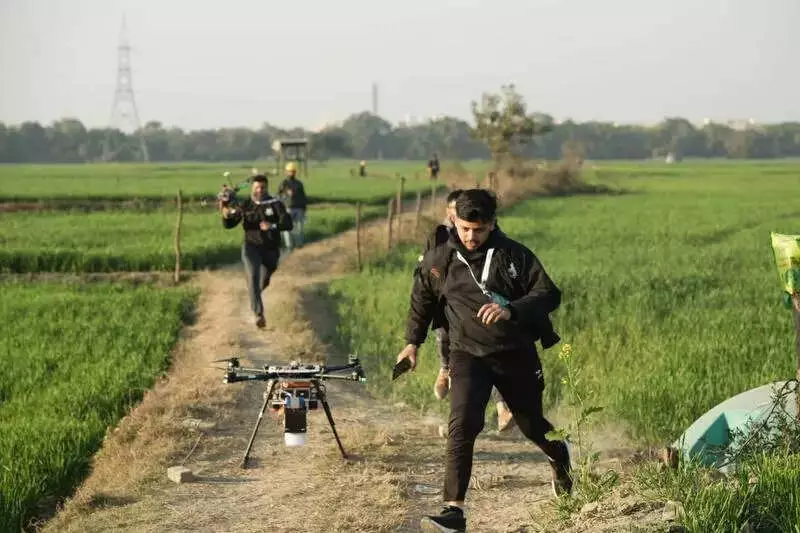
Students Across India Showcase Drone Solutions for Real-World Problems
Greater Noida is buzzing with innovation this week. Students from all corners of India are putting drones to the test for disaster response and farming applications. They are participating in the final phase of the National Innovation Challenge for Drone Application and Research, known as NIDAR 2026. The event is happening at Gautam Buddha University in Greater Noida.
A Massive Gathering of Young Innovators
The seven-day challenge concludes on January 16. It has drawn an impressive crowd. More than 3,500 students have gathered here. They represent over 350 teams from institutions nationwide. The Drone Federation India organized this event. They collaborated with the Ministry of Electronics and Information Technology, or MeitY.
This challenge focuses squarely on practical uses for drones. Officials emphasize real-world applications in two critical areas. The first is disaster response. The second is precision agriculture. These fields reflect the growing role of drones in governance and public welfare.

From Evaluation to Final Mission
Teams went through multiple evaluation rounds. Only 150 teams advanced to this final stage. Now they are working on advanced applications. In disaster management, their tasks include geotagging affected areas. They are also developing search and rescue support systems. Another key task is emergency medical delivery using drones.
For precision agriculture, the challenges are equally demanding. Teams must program drones for autonomous navigation over farmlands. They need to assess crop health accurately. A crucial task involves identifying low-productivity zones within fields. This helps farmers target interventions better.
A senior official from the organizing committee explained the setup. Each team must deploy two drones. These drones must operate autonomously and in coordination with each other. In disaster scenarios, one drone identifies needs on the ground. The other drone delivers essential supplies. For agriculture, paired drones work together to assess crop conditions and map productivity.
Personal Motivation Drives Innovation
Many participants shared their inspiration. Recent natural disasters and agrarian distress moved them deeply. One participant recalled seeing villages in Punjab and other flood-hit states. These areas remained cut off for days after floods. The student felt drones could offer the fastest way to deliver medicines and food. Traditional vehicles or boats often cannot reach such isolated spots.
Another participant is focusing on agricultural applications. Their aim is straightforward. They want to help farmers make timely decisions. Early detection of crop stress can save an entire season for small farmers. The student stressed that technology must reach the field. It should not remain confined to laboratories.
Building a Skilled Talent Base for India's Future
Drone Federation India president Smit Shah highlighted the challenge's design. It encourages mission-oriented innovation. These missions align with national priorities. When students work on disaster relief and precision farming, they contribute directly to India's strategic and industrial goals.
Preeti Nath serves as the economic advisor to MeitY. She noted that NIDAR is helping build a skilled talent base in unmanned systems. This is critical for India's technological future. Nath called this the country's first national-level drone innovation challenge of such scale. It enables young engineers to contribute directly to India's digital growth. It also fosters strategic self-reliance.
Professor Rana Pratap Singh is the vice-chancellor of Gautam Buddha University. He said this platform allows students to translate classroom learning into practical solutions. It prepares them to think, design, and deploy technologies. These technologies can make a tangible difference during disasters. They can also strengthen national food security.
Teams demonstrating the highest precision and accuracy will be shortlisted for awards. The event showcases how student innovation can address pressing national challenges through advanced drone technology.