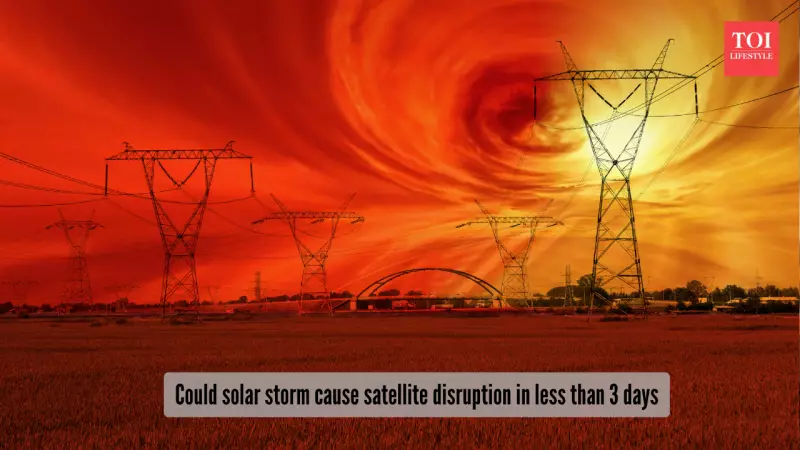
Our modern, connected world faces a potentially catastrophic threat from space, according to alarming new research. A powerful solar storm could cripple the vast networks of satellites orbiting Earth, triggering a devastating chain of collisions in a matter of days and turning the increasingly crowded skies into a disaster zone.
The Crowded Highway Above Us
Daily life in India and across the globe is now deeply reliant on the thousands of satellites buzzing in low-Earth orbit. These spacecraft are the unseen backbone of our digital existence, enabling mobile phone connectivity, precise GPS navigation, and seamless internet streaming. Imagine this orbital region as an ultra-high-speed highway, but one that is becoming dangerously packed.
The study highlights that the situation has reached a critical point of congestion. Currently, on average, two satellites pass within 1 kilometre of each other every 22 seconds. To prevent catastrophic crashes, ground-based operators are in a constant state of alert, performing delicate manoeuvres to adjust their paths. This entire system, however, hinges on one crucial factor: stable and reliable communication and navigation links between Earth and space.

The Solar Storm Trigger and the CRASH Clock
The research, led by Princeton PhD student Sarah Thiele, investigates the domino effect that could be unleashed by a massive solar storm. These storms, eruptions of charged particles from the sun, pose a dual threat. First, they can increase atmospheric drag, slowing satellites down and pulling them into slightly lower, more congested orbits. This small shift dramatically increases the risk of close encounters, forcing operators to execute many more avoidance moves.
The greater danger, however, is a complete loss of control. Intense solar activity can damage or disrupt the very navigation and communication systems that satellites and their ground teams depend on. If these systems fail, corrective commands cannot be sent. In the worst-case scenario, operators could lose real-time control of entire fleets of satellites simultaneously.
To quantify this risk, the researchers developed a new tool called the CRASH Clock (Collision Realisation and Significant Harm). Using this model, they simulated scenarios where satellites suddenly stop receiving commands. The findings are stark: in such loss-of-control situations, collisions begin to occur with frightening speed.
A Ticking Time Bomb in Orbit
The study presents a sobering timeline. It estimates that by June 2025, if a solar storm causes satellites to lose control, a major cascade of collisions could begin in just 2.8 days. This window has shrunk alarmingly; back in 2018, the same chain reaction would have taken about 121 days to initiate. This sharp reduction underscores how dangerously packed low-Earth orbit has become. Even a brief 24-hour loss of control now carries roughly a 30% chance of a serious collision.
This scenario risks triggering the dreaded Kessler Syndrome – a catastrophic chain reaction where one collision creates a cloud of debris that smashes into other satellites, generating even more space junk. This self-sustaining cascade could render key orbital regions unusable, making normal satellite operations impossible and new launches prohibitively risky for decades.
The paper also examines an extreme event: a solar storm on the scale of the historic Carrington Event of 1859. The researchers conclude that a storm of such magnitude today would likely overwhelm our current control systems. Humanity could lose command of a significant portion of its satellite fleet for more than three days, potentially destroying a large share of the critical infrastructure that underpins modern navigation, communication, and security.
The message from the study is clear: as our dependence on orbital technology grows, so does our vulnerability to cosmic weather. The time to develop more robust safeguards and contingency plans is now, before the next big storm hits.