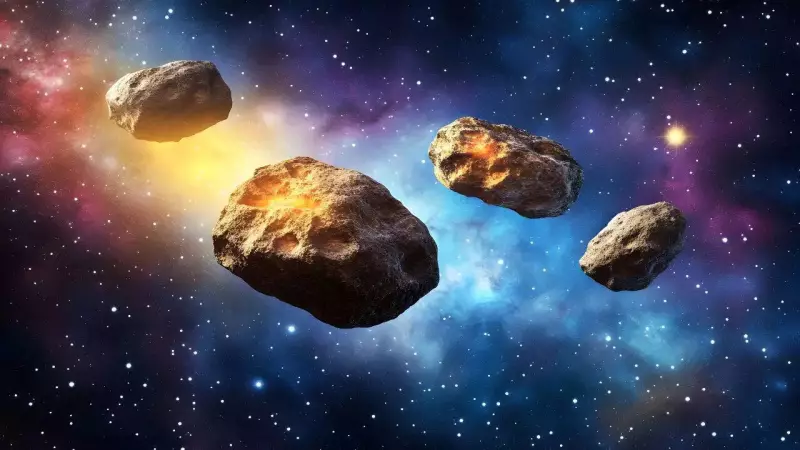
For decades, asteroids have been viewed as distant, silent, and barren rocks drifting through the void of space. This perception is undergoing a radical shift. Groundbreaking research now suggests that certain asteroids, particularly the smaller ones, could be treasure troves of immense economic and scientific value, potentially fuelling humanity's next giant leap into the cosmos.
Why Small Asteroids Are The Prime Targets
While large asteroids often grab headlines, smaller celestial bodies are emerging as the most promising targets for future space mining operations. Many of these small asteroids possess a primitive chemical composition, meaning they have remained largely unchanged since the dawn of our solar system. This makes them invaluable scientific "time capsules." According to research published in Oxford Academic, studying meteorites from these asteroids has revealed they contain carbon, organic elements, and precious metals.
The focus is particularly on a rare class of meteorites known as carbonaceous chondrites, believed to originate from carbon-rich asteroids. These space rocks are known to contain water-bearing minerals and organic materials essential for life. Scientists use advanced techniques like mass spectrometry to analyse them. This analysis is crucial because these fragile meteorites often break apart when entering Earth's atmosphere, making intact samples on asteroids even more valuable.

Fueling the Future: From Moon Bases to Mars Missions
The potential applications of asteroid resources are transformative. Water found on asteroids can be processed into rocket fuel and life-support systems directly in space, eliminating the colossal cost of launching these heavy resources from Earth. Similarly, metallic elements like iron, nickel, and platinum-group elements (PGEs) could be used for construction and manufacturing in space, supporting future lunar bases or missions to Mars.
The current scientific consensus is clear: the goal is not necessarily to bring these resources back to Earth, but to utilise them in situ to build a sustainable infrastructure in space. This approach, known as In-Situ Resource Utilisation (ISRU), could revolutionise deep-space exploration by making missions more self-sufficient and less reliant on Earth-bound supplies.
The Daunting Challenges Ahead
Despite the exciting promise, the path to asteroid mining is fraught with significant technical hurdles. Operating in a low-gravity environment presents unique difficulties, especially when dealing with small bodies often covered in loose, rocky material. While current technology allows for the collection of samples—as demonstrated by missions like OSIRIS-REx—it is not yet suited for large-scale, commercial extraction.
Experts estimate that it could take several decades to establish viable space mining operations. However, the long-term payoffs are monumental. Success would not only propel space exploration forward but also reduce our dependence on Earth's finite resources. Additionally, the technology developed could enhance our ability to monitor and potentially deflect asteroids that pose a threat to our planet. What was once a fantastical dream is now a serious scientific and engineering pursuit, being tackled with increasing diligence.