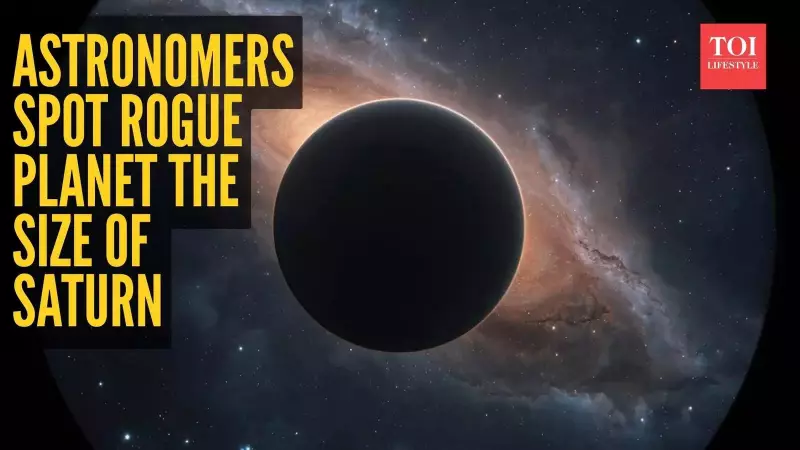
In a remarkable cosmic discovery, astronomers have identified a planet that travels through the void of space without orbiting any star. This solitary wanderer, roughly the size of Saturn, provides a rare glimpse into the mysterious population of free-floating planets that roam our galaxy unseen.
What Is a Rogue Planet?
Unlike familiar planets in our solar system, such as Earth or Mars, which are bound by gravity to orbit the Sun, rogue planets have no such stellar anchor. These dark, nomadic worlds drift through interstellar space, emitting almost no light of their own, which makes them exceptionally difficult to detect.
To find these elusive objects, scientists rely on a clever technique known as gravitational microlensing. When a rogue planet passes in front of a distant star, its gravity acts like a lens, bending and magnifying the star's light for a brief moment. By meticulously monitoring these subtle, fleeting brightening events, astronomers can infer the presence of a hidden planet.

The Discovery: A Fleeting Signal from the Dark
As detailed in an NDTV report, this particular rogue planet was identified by a research team led by Subho Dong from Peking University and the National Astronomical Observatories of the Chinese Academy of Sciences. The key was an extremely short microlensing event, so brief it could easily have been overlooked.
The observation was a feat of coordination, utilizing data from both ground-based telescopes on Earth and the Gaia Space Telescope, positioned nearly a million miles away. By comparing the minuscule differences in how the lensed starlight reached these separate locations, researchers could precisely calculate the planet's mass and its distance from us. Ground surveys provided crucial confirmation of these findings.
A World Without a Home: Size and Origins
The analysis revealed a fascinating profile for this cosmic drifter. The planet possesses approximately 22 percent of Jupiter's mass, placing it firmly in a size category similar to Saturn. It is located an estimated 3,000 parsecs from the center of our Milky Way galaxy.
Based on its mass, scientists theorize this world likely formed in a planetary system around a young star. A violent gravitational encounter, perhaps with a massive neighboring planet or a companion star in a binary system, then violently ejected it into the interstellar darkness. It is, in essence, a planetary orphan cast out from its birthplace.
Why This Discovery Matters for Science
Each discovery of a free-floating planet is a significant piece in the puzzle of galactic evolution. These rogue worlds represent some of the least understood objects in space. Studying them helps astronomers test theories about how planetary systems form, evolve, and sometimes disintegrate.
Every new find, like this Saturn-sized wanderer, adds depth to our understanding of the diverse and dynamic population of planets in our galaxy. It underscores that beyond our familiar solar neighborhood, planets exist in astonishing variety and under extraordinary circumstances, far from the warmth of any sun.