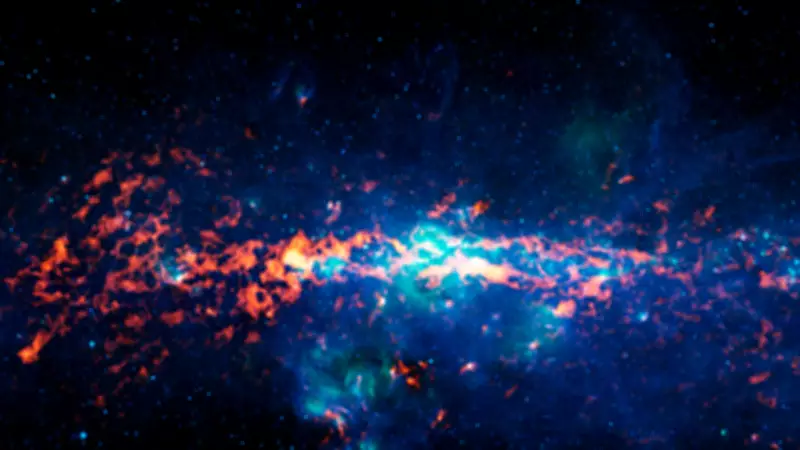
Close to the center of our galaxy lies an immense molecular cloud known as Sagittarius B2, a subject of scientific intrigue due to its peculiar composition. This cloud contains chemicals that give it the aroma of rum and the taste of raspberries, specifically ethyl formate, which produces the raspberry-like flavor and sweet smell of rum. Sagittarius B2 is one of the largest clouds of dust and gas in space, situated near the galactic center. Researchers believe this strange region could provide clues on how complex organic compounds develop in interstellar space.
What Is Sagittarius B2 in the Milky Way and Why Does It Fascinate Astronomers?
Sagittarius B2 is one of the largest molecular clouds, located about 390 light-years from the galactic center of the Milky Way. It is close to Sagittarius A*, a supermassive black hole at the galaxy's center. The cloud spans about 150 light-years and consists of gas, dust particles, and molecules. For years, scientists have studied Sagittarius B2 as a natural chemistry lab in space. The research team at the Max Planck Institute for Radio Astronomy found that this cloud contains numerous carbon compounds, ranging from alcohols to acids, including those related to biological chemistry. The molecule that gained international attention is ethyl formate, which imparts raspberries their characteristic flavor and gives rum its odor. This discovery was made using the IRAM 30-meter radio telescope in Spain.
Why the Cosmic Cloud Smells Like Rum and Tastes Like Raspberries
Although no one can actually smell or taste Sagittarius B2, researchers use terrestrial odors to describe its composition. Ethyl formate is an organic compound called an ester, typically associated with fruity flavors and fragrances. According to the Australian Academy of Sciences, the detection of ethyl formate in an interstellar cloud is like detecting a molecule that tastes like raspberry and smells like rum. However, the cloud also contains more hazardous substances, such as methanol. Additionally, the region near the galactic center experiences extreme temperatures and radiation levels. Based on estimates, the amount of ethyl formate in the cloud could produce tons of so-called "space rum."

How Interstellar Chemistry Could Explain the Origins of Life
The organic molecules found in Sagittarius B2 are significant because they confirm that complex chemistry occurs naturally in outer space. Experts claim these molecules could be involved in stellar evolution and in providing the necessary components for life. According to the European Southern Observatory, another molecule called n-propyl cyanide was also found in this cloud. The presence of such complex molecules indicates that even more complicated molecules can form in space through natural chemical processes. This research has a huge impact on modern astrochemistry, the branch of science studying molecule behavior in space environments. Future discoveries may be made using new radio telescopes and deep-space expeditions.
Why the Milky Way's "Cosmic Cocktail" Still Fascinates Scientists
While the thought of an immense cloud smelling of rum and tasting of raspberries sparks imagination, there is much more to Sagittarius B2 for researchers. It is considered one of the best examples of natural chemical processes in deep space. For scientists, this object provides hints about planet formation and the chemical evolution of galaxies. For everyone else, it remains a testament to how surprising and unpredictable our universe is.