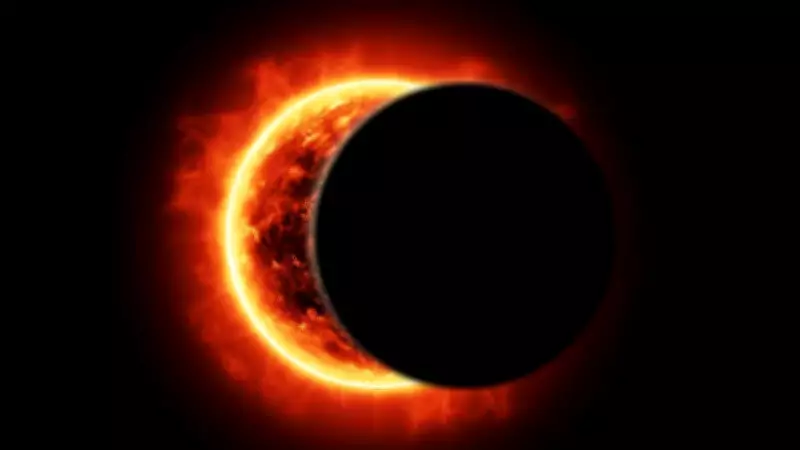
Ring of Fire Solar Eclipse to Illuminate Skies on February 17, 2026
On February 17, 2026, skywatchers worldwide will have the opportunity to witness one of the most visually striking celestial events: an annular solar eclipse, famously known as the 'ring of fire'. This astronomical phenomenon occurs when the Moon passes directly between the Earth and the Sun, but unlike a total solar eclipse, it does not completely obscure the solar disc. Instead, it leaves a slender, glowing ring of sunlight visible around the Moon's dark silhouette, creating a breathtaking spectacle.
Understanding the Annular Eclipse Phenomenon
The term 'annularity' refers to the precise moment during an eclipse when the Moon is positioned in front of the Sun but fails to cover it entirely. Derived from the Latin word annulus, meaning ring, this phase results in the Sun forming a thin, fiery ring around the Moon, hence the dramatic nickname. During annularity, the sky does not turn fully dark as it does in a total eclipse. Instead, experts note that the light dims significantly, shadows become sharper, and the atmosphere takes on an eerie, twilight-like quality in the middle of the day. However, unlike total eclipses, annular events are subtler, with no dramatic temperature drops or visible stars.
Why the Ring of Fire Occurs
The occurrence of an annular eclipse is intricately linked to the Moon's orbit around Earth. The Moon does not follow a perfect circular path; its orbit is slightly oval-shaped, causing its distance from Earth to constantly vary. When the Moon is at its closest point, it can completely cover the Sun's disc, leading to a total eclipse. On February 17, 2026, the Moon will be positioned slightly farther away, making it appear marginally smaller than the Sun in the sky. As a result, when it slides in front of the Sun, it cannot fully obscure it, allowing the iconic ring of fire to form.

Path of Annularity and Viewing Details
The full ring of fire effect will only be visible from a narrow path across Antarctica, making it a rare sight accessible to very few observers, primarily research station crews. This path, known as the path of annularity, is essentially a corridor on Earth where the Moon appears perfectly sized to create the ring. Outside this path, viewers in other regions, such as parts of southern Africa and the southern tip of South America, will witness only a partial eclipse, where much of the Sun remains visible.
The eclipse timeline, as reported by Time and Date, unfolds as follows:
- Partial eclipse begins: 4:56 am EST (0956 GMT)
- Maximum ring of fire: 7:12 am EST (1212 GMT)
- Partial eclipse ends: 9:27 am EST (1427 GMT)
At its peak, the fiery ring will be visible for up to 2 minutes and 20 seconds. The path of annularity stretches approximately 2,661 miles in length and 383 miles in width, highlighting how narrow and specific the viewing area is.
Safety Precautions for Eclipse Viewing
Experts strongly emphasize the importance of safety when observing solar eclipses. It is crucial to never look directly at the Sun without proper solar eclipse glasses, even during annularity or partial phases. Ordinary sunglasses do not provide adequate protection and can lead to serious eye damage. Always use certified solar filters to enjoy this celestial event safely.
This annular solar eclipse offers a unique opportunity to marvel at the wonders of our solar system, reminding us of the intricate dance between the Earth, Moon, and Sun. Whether viewed in person or through broadcasts, it promises to be a memorable experience for astronomy enthusiasts and casual observers alike.