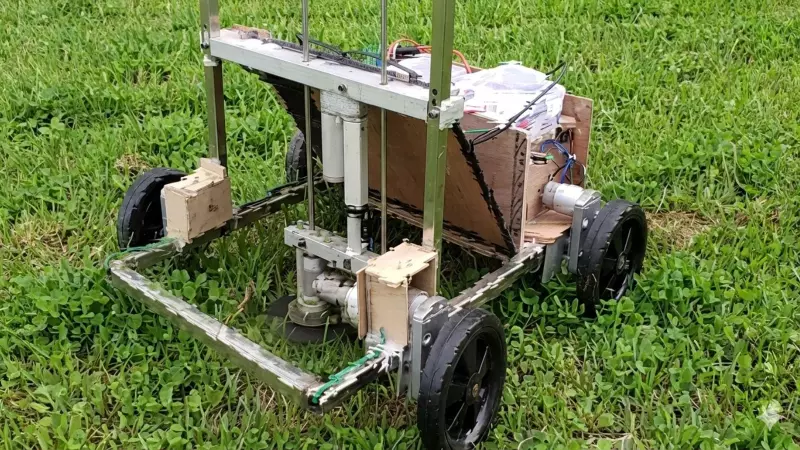
In a breakthrough for automated landscaping and precision robotics, Panjab University (PU) has secured an Indian patent for a novel invention that transforms ordinary lawn maintenance into an art form. The university's Design Innovation Centre (DIC) is now the patent holder for an autonomous robot known as the 'Grass Printer'. This system is capable of cutting grass at different levels to produce letters, symbols, and complex patterns, effectively turning lawns into large-scale canvases for messages and branding.
The Invention and Its Intelligent Design
The patent has been officially granted to Professor Naveen Aggarwal and his dedicated research team. Their invention is formally titled 'Grass Printer: An Automated Multi-Level Grass Cutter to Make Character Impression on Grass'. While it functions on the basic principle of a robotic lawn mower, the Grass Printer incorporates advanced intelligence that sets it apart.
This added smart technology enables the robot to print visible designs and text on grass by creating contrasts through multi-level cutting. It operates autonomously, navigating across gardens and open grounds without constant human intervention. The key to its operation is a unique cutting mechanism that trims grass at various heights, resulting in clear impressions that are visible from a distance.

User-Friendly Operation and Broad Applications
One of the most significant features of the Grass Printer is its ease of use. Operators can simply input the desired text or pattern through a dedicated mobile application. This user-friendly interface simplifies the entire process and substantially reduces the need for manual labor and specialized horticultural skills.
The potential applications for this technology are vast, particularly for spaces with large maintained lawns that also serve visual or branding purposes. The innovation is poised to be highly useful at:
- Airports
- Sports stadiums and complexes
- Corporate parks and office campuses
- Public gardens and parks
- University campuses
Endorsement and Future Implications
PU Vice-Chancellor Renu Vig commended the development, stating that it aligns perfectly with national objectives focused on fostering innovation and achieving self-reliance in technology. Professor Aggarwal emphasized that the patent underscores Panjab University's commitment to practical and applicable research. He highlighted that the system democratizes advanced landscaping, making it possible to execute complex designs in large public areas without requiring operators to have deep technical expertise.
The robot is equipped with a sophisticated multi-level cutting system, distinguishing it from conventional single-height mowers. It also features a manual training mode. In this mode, a human operator guides the robot once over an area to map its boundaries and layout. After this single training session, the Grass Printer can independently repeat the task, efficiently manage its own power consumption, and autonomously return to its charging or starting point upon job completion.
This patent marks a significant step forward for Indian innovation in robotics and automation, presenting a smart solution that merges utility with creativity for large-scale green spaces.