For decades, Mars has been pictured as a silent, barren world, a realm of dust and wind with an almost eerie quiet. This perception, reminiscent of the desolate Abyss from the popular series 'Stranger Things', is now changing. A groundbreaking discovery by NASA's Perseverance rover has added a new, crackling layer of sound—and mystery—to the Red Planet.
The First Crackle: Recording Martian Lightning
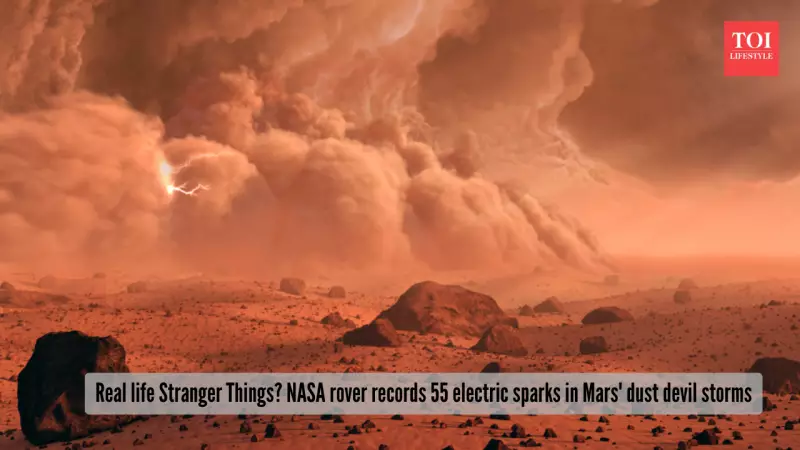
In a historic first, the microphone on Perseverance's SuperCam instrument has picked up the distinct sound of electrical discharges on Mars. The rover recorded a sharp crackling noise during the passage of a dust devil in the Jezero Crater. This event marks the first direct evidence of lightning occurring on the Martian surface.
Over a period of two years, the sensitive equipment detected 55 such discharges, predominantly associated with dust devils or larger storms. Unlike Earth's dramatic, sky-splitting bolts, these Martian sparks are tiny, centimeter-scale events that sound more like static zaps. Lead author Baptiste Chide from France's Institut de Recherche en Astrophysique et Planétologie confirmed the findings through detailed audio analysis.

The Spark's Origin: Friction in Thin Air
So, what creates these miniature bolts on a planet known for its thin atmosphere? A study published in the journal Nature provides the answer. The mechanism is triboelectric charging. As countless dust grains violently rub against each other within Martian whirlwinds, they build up a static charge—similar to rubbing a balloon on your hair. This friction eventually leads to a discharge, a mini electrical arc.
Researchers estimate the energy of these sparks to be up to 40 millijoules. Laboratory tests using a device called a Wimshurst machine successfully replicated both the sounds and the electromagnetic signals detected by Perseverance. As planetary scientist Ralph Lorenz explained to Reuters, it's "a small spark, possibly just a few millimeters" in size. While theorized for years, this is the first time the phenomenon has been directly observed.
Implications for Chemistry and the Hunt for Life
This discovery has significant consequences for understanding Mars and the ongoing search for ancient life. The electrical sparks may be actively altering the Martian surface chemistry. Baptiste Chide told Science News that "the discharges may spark a reaction that generates oxidants like hydrogen peroxide." These potent oxidants can break down organic molecules, which are the building blocks of life.
This process likely explains the highly reactive soil that earlier missions like Viking and Phoenix encountered. While samples collected by Perseverance are safely stored within its robust frame, future missions designed to hunt for biosignatures will need to account for this surface effect and potentially include shielding for sensitive instruments.
For now, the tiny zaps pose no major risk to current rovers, though repeated exposure could gradually wear down insulators or sensors. The finding has already sparked calls for future crewed missions in the 2030s to carry dedicated electric field measurement tools. Meanwhile, the SuperCam's unique playlist of Martian sounds—featuring howling winds, the whir of the Ingenuity helicopter's blades, and now these electric crackles—proves that microphones are a vital tool for planetary exploration, making distant worlds feel startlingly alive.