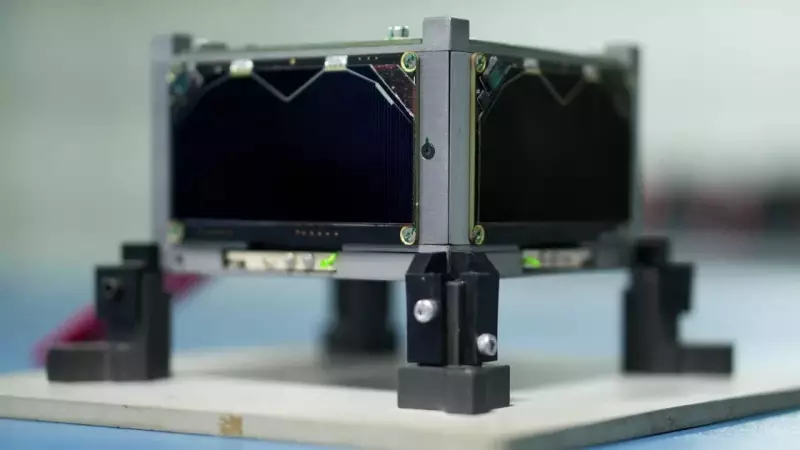
In a landmark achievement for applied space technology in the state, a communication satellite developed by a private university in Bhubaneswar is scheduled for launch on January 12. The satellite will ride aboard the Indian Space Research Organisation's (ISRO) PSLV-C62 rocket, marking Odisha's pioneering foray into this high-tech domain.
A Collaborative Effort for Resilient Communication
The satellite, named CGUSAT-1, is the result of a collaboration between CV Raman Global University (CGU) and Hyderabad-based Dhruva Space, a full-stack space engineering solutions provider. The launch is part of Dhruva Space's 'Polar Access-1' programme.
University officials stated that CGUSAT-1 is designed to demonstrate how small satellites can maintain communication continuity when traditional networks fail. The project followed rigorous industry-grade workflows, including subsystem verification, interface testing, integration rehearsals, and mission readiness reviews to ensure success.

Built for Disaster Management and Student Learning
Soumya Mishra, an assistant professor of electronics and communication engineering who also serves as the custodian of the university's 'Space Club' and ground station, revealed that the team spent approximately a year building the satellite. She emphasized its critical role in emergencies.
"Communication networks are often the first to collapse during emergencies or natural disasters," Mishra explained. "Our satellite will facilitate connections from our ground station to similar facilities in affected areas, enabling communication with relief centers. This facility can also be utilized by government agencies."
The satellite will be deployed in orbit using Dhruva Space's DSOD-1U separation system. The company also assisted CGU in configuring its licensed VHF/UHF ground station and mission control centre for upcoming operations.
Hands-On Experience for the Next Generation
The project has provided invaluable practical experience for students. Debadutta Sahoo, a student from Mishra's department, said they are learning about wireless communication and ground station operations through this initiative.
"The satellite is expected to play a vital role in disaster management and emergency communication, as it can function even when conventional systems fail," Sahoo noted. "It can support coordination and information sharing during cyclones, floods, and earthquakes."
Another student, Rahul Kumar Gupta from the computer science engineering department and an active 'Space Club' member, highlighted the project's broader impact. "Our university is preparing for the CGUSAT-1 mission, a student-built CubeSat, which will open more opportunities for students to engage in space research and satellite communication projects," he added.
Mission Readiness and Future Roadmap
In preparation for the launch, students and faculty conducted extensive communication rehearsals, telemetry decoding tests, and pass simulations. Once CGUSAT-1 is in orbit, CGU will manage full mission operations from its campus ground station.
The university's official statement outlined that the mission's in-orbit dataset will form the cornerstone for CGU's long-term research in satellite communication, message-relay experiments, and advanced space systems engineering. This launch is not just a singular event but the foundation for sustained innovation and education in India's growing private space sector.