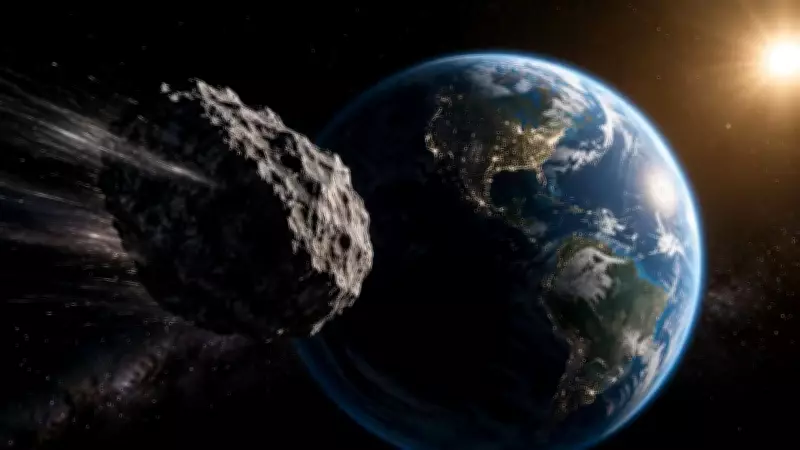
NASA is tracking asteroid 2026 HW2, a building-sized space rock currently moving through Earth's orbital neighborhood. Traveling at nearly 44,000 kilometers per hour, the asteroid is expected to make its closest approach to Earth around 4:30 pm IST today. Despite the attention surrounding it, scientists confirm there is no danger of collision. The object will remain roughly 6.77 million kilometers away, a distance far beyond any realistic threat.
Monitoring Near-Earth Objects
NASA and other observatories continue monitoring such near-earth objects as part of long-term planetary defense efforts. Each observation helps astronomers refine orbital calculations, improve tracking systems, and better understand how frequently these rocky bodies pass through the inner solar system.
The object in question, 2026 HW2, is not newly discovered but has recently entered public conversation as its orbit brought it into a monitored window. It is estimated to be about the size of a large building, though these measurements are derived from brightness readings and modeling rather than direct photography. The asteroid is moving at around 44,000 kilometers per hour, typical for bodies in solar orbits. The key point from tracking data is not the speed but the path, which carries it well outside any collision course with Earth based on current calculations.

What Scientists Are Actually Looking At
When astronomers flag an object like this, it is not because there is an expectation of impact. It is routine. These near-earth objects are logged, followed, and recalculated as fresh observations come in. Small shifts in brightness or position are folded into orbital models, which are then projected forward. Asteroid 2026 HW2 belongs to a category of objects that regularly cross Earth's orbital neighborhood. Some paths drift close enough to warrant continued attention, even if they remain comfortably distant in practical terms.
What matters to monitoring systems is uncertainty. Early readings always carry a margin of error, and that margin shrinks over time as more telescopic data is gathered.
Science Behind NASA's Close Approach
The figure often quoted is around 6.77 million kilometers. To put it in perspective, the moon sits about 384,000 kilometers away from Earth. This asteroid will pass at many times that distance. Space, even in what astronomers call the inner solar system, is mostly empty. Objects can be described as near each other while still being separated by distances that make any physical interaction impossible.
This is where public perception often diverges from scientific language. Close approach is a technical term, not a warning. It simply marks when an object crosses a defined monitoring threshold.
Why Do These Objects Keep Getting Tracked
There is a long-standing reason agencies like NASA maintain continuous surveys of near-earth objects. It is not about any single asteroid but about patterns over time. Most of these bodies pass quietly and are never widely noticed. A small fraction are large enough or erratic enough in orbit to deserve extended observation.
Tracking is done through repeated imaging, sometimes across different observatories, then combined into a model of where the object has been and where it is going. Each pass improves accuracy. Even when nothing unusual happens, the dataset becomes more reliable for the next object that comes along.