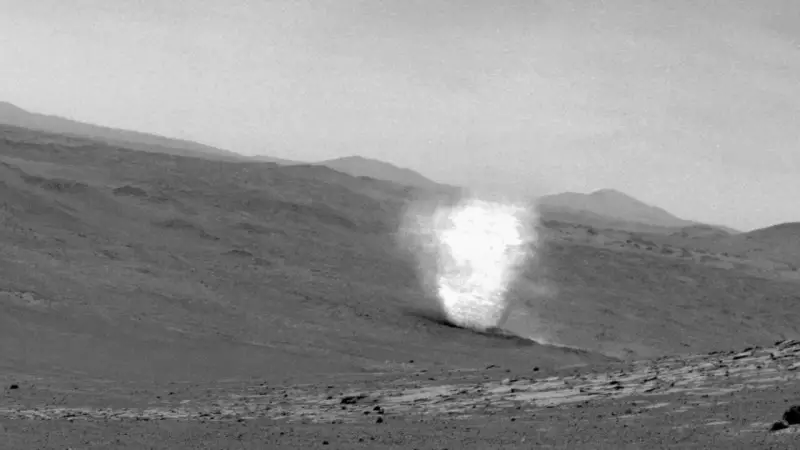
In a groundbreaking discovery, NASA's Perseverance rover has provided the first concrete evidence for a phenomenon scientists have speculated about for decades: tiny electric sparks are crackling within Martian dust devils and storms. This finding, which could fundamentally alter our understanding of the Red Planet's atmospheric chemistry and potential for life, is based on direct audio and electromagnetic data collected by the rover's instruments.
The Snap Heard from Another World
The discovery stems from data gathered by the Perseverance rover's SuperCam microphone. Since 2021, the instrument has detected 55 distinct electrical discharge events. Remarkably, 16 of these events occurred when dust devils passed directly over the rover. According to Ralph Lorenz, a Perseverance scientist at the Johns Hopkins Applied Physics Lab and a co-author of the study published in Nature, the recordings are unmistakable.
"We got some good ones where you can clearly hear the ‘snap’ sound of the spark," Lorenz stated. He highlighted two specific recordings. In the event from Martian day, or Sol, 215, one can hear the electrical sound along with the wall of the dust devil moving over the rover. The recording from Sol 1,296 captured the spark, the dust devil's movement, and even the sound of particles impacting the microphone itself.

Solving a Martian Mystery: Triboelectric Charging
Dust devils, which are spinning columns of warm, dust-laden air, are common on Mars. Scientists had long theorized that the friction between countless tiny dust grains swirling inside these vortices could generate triboelectric charging—the same process that creates a static shock when you walk across a carpet. Perseverance's data has now confirmed this hunch.
Lead researcher Dr. Baptiste Chide described these discharges as "mini-lightning." One significant spark was recorded roughly six feet from the rover, with several smaller ones occurring just inches from the microphone. "What we are seeing are tiny sparks, but on Mars, even tiny sparks can tell us a lot about the atmosphere," Dr. Chide explained. The research also revealed that 35 other electrical events were linked to turbulent fronts during larger regional dust storms.
Implications for Mars Science and Future Missions
The implications of this discovery are wide-ranging. Even these small sparks can trigger chemical reactions in the thin Martian atmosphere, potentially forming highly oxidizing compounds like chlorates and perchlorates. These substances could destroy organic molecules on the surface and may help explain the puzzlingly rapid disappearance of methane detected in the Martian air.
Furthermore, electrostatic forces likely play a key role in how dust is lifted and moved across the planet, a critical but poorly understood factor in modeling Mars's climate. While the sparks are too small to directly harm future astronauts, experts note that repeated discharges could interfere with sensitive electronics or gradually degrade spacesuit materials over time.
The scientific community has welcomed the findings but urges caution. As noted in a Nature commentary by particle physicist Dr. Daniel Pritchard, the lack of visual confirmation means some doubt remains. Researchers hope that future Mars missions will carry more sensitive cameras and dedicated instruments to visually capture and further study these micro-sparks, reshaping our plans for both robotic and human exploration of the Red Planet.