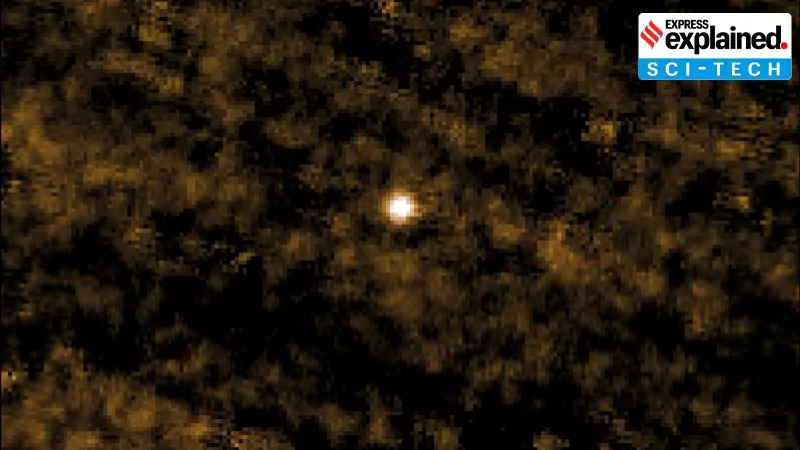
The National Aeronautics and Space Administration (NASA) has unveiled breathtaking new images of Comet 3I/Atlas, marking a significant milestone in space exploration. This interstellar visitor, determined to be billions of years old, represents only the third such object ever discovered passing through our solar system.
Capturing the Cosmic Wanderer
The newly released images showcase Comet 3I/Atlas as observed between September 28 and October 10, 2025, when the comet was approximately 231 million to 235 million miles from Earth. These remarkable visuals come from NASA's Polarimeter to Unify the Corona and Heliosphere (PUNCH) mission, displaying daily stacked images that capture the comet's movement across the sky with stars creating dramatic light streaks in the background.
What makes this discovery particularly exciting is the collaborative effort behind it. The data was gathered from an impressive array of NASA missions, including the Perseverance Mars rover, MAVEN orbiter, Psyche, Lucy, and PUNCH spacecraft. This multi-mission approach provides scientists with unprecedented perspectives on this interstellar traveler.

The Journey of Comet 3I/Atlas
Comet 3I/Atlas was first detected on July 1, 2025 by the Asteroid Terrestrial-impact Last Alert System (ATLAS) survey telescope located in Río Hurtado, Chile. At the time of its discovery, the comet was approximately 670 million kilometers from the Sun. Astronomers have calculated that the object will make its closest approach to Earth on December 19, 2025, passing at a distance of about 170 million miles – nearly twice the distance between Earth and the Sun.
This celestial visitor joins an exclusive club of known interstellar objects, following the discoveries of 1I/ʻOumuamua in 2017 and 2I/Borisov in 2019. The detection of these objects has revolutionized our understanding of cosmic traffic passing through our solar neighborhood.
Understanding Interstellar Objects
Interstellar objects are celestial bodies that originate outside our solar system and travel through interstellar space – the vast regions between stars. Unlike objects bound to our Sun by gravity, these cosmic wanderers move freely through space, potentially having been ejected from their home solar systems through collisions or gravitational interactions with large planets.
Scientists have long theorized that numerous interstellar objects pass through our solar system regularly, but their small size and faint appearance made detection nearly impossible until recent technological advancements. The development of more powerful telescopes and sophisticated detection systems has finally allowed astronomers to spot these elusive travelers.
How Scientists Identify Interstellar Visitors
The key to identifying interstellar objects lies in analyzing their trajectories. Objects within our solar system follow closed elliptical orbits around the Sun, with predictable changes in speed as they move between perihelion (closest approach to the Sun) and aphelion (farthest point from the Sun).
In contrast, interstellar objects like Comet 3I/Atlas follow open-ended hyperbolic orbits. These paths feature a perihelion point but no aphelion, meaning the objects move at such high velocities that the Sun's gravitational pull cannot capture them into permanent orbits. Instead, they simply pass through our solar system before continuing their journey into deep space.
Scientists determined 3I/Atlas's interstellar nature by observing its remarkable speed of 60 kilometers per hour at a distance of 670 million kilometers from the Sun. This velocity is exceptionally high for such a distance, where solar gravity typically slows objects significantly. This indicated that the comet must have entered our solar system with substantial initial speed, confirming its interstellar origins.

The Scientific Significance
The study of interstellar objects like 3I/Atlas and ʻOumuamua provides scientists with unprecedented opportunities to understand planetary formation in distant solar systems. By analyzing the chemical composition of these visitors, researchers can gather crucial information about the conditions in their home systems and the processes that formed them.
The presence of specific materials, such as ice concentrations, can reveal how far from their parent star these objects formed and what type of gravitational interactions ejected them into interstellar space. As the European Space Agency notes, "It may be thousands of years until humans visit a planet in another solar system and interstellar comets offer the tantalising opportunity for us to touch something truly otherworldly. These wanderers offer a rare, tangible connection to the broader galaxy – to materials formed in environments entirely unlike our own."
Each interstellar object serves as a natural probe from distant cosmic neighborhoods, carrying chemical signatures that tell stories about worlds far beyond our current reach. As detection capabilities continue to improve, scientists anticipate discovering more of these cosmic messengers, potentially revolutionizing our understanding of planetary formation throughout the galaxy.