The centre of the Milky Way is not an easy place to study. Dense clouds of dust drift between countless stars, obscuring much of what lies beyond them. From Earth, that region appears as a bright and crowded stretch of the night sky, but hidden within it are objects that have remained largely unchanged for billions of years.
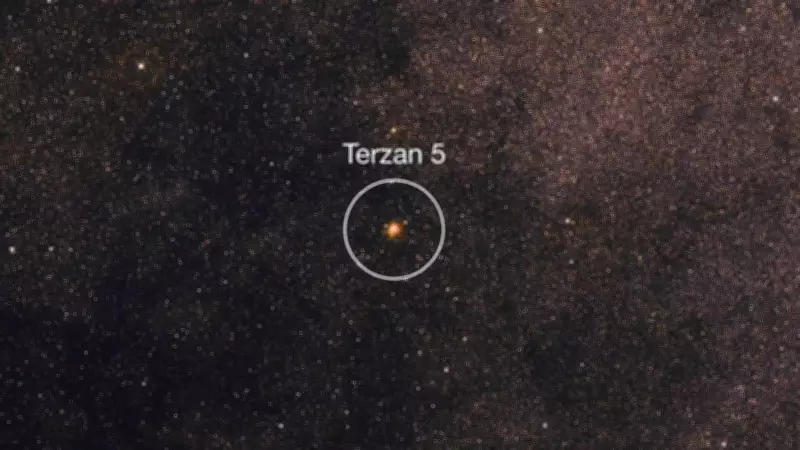
A newly released visualisation from NASA traces a path into this busy galactic interior, guiding viewers from a broad view of the Milky Way towards a compact stellar system known as Terzan 5. The journey ends with a detailed image assembled from observations by the James Webb and Hubble space telescopes. What appears at first glance to be another tightly packed cluster of stars has gradually emerged as something far less ordinary.
Terzan 5 is hidden within the Milky Way's crowded bulge
The zoom sequence begins with a view of the Milky Way's central bulge, a densely populated region where ancient stars dominate the landscape. According to NASA's visualisation, Terzan 5 sits within this crowded environment, surrounded by stars and veiled by dust that has complicated observations for decades.

Its location alone makes it unusual. Objects in the bulge are often difficult to distinguish from one another because of the sheer number of stars concentrated in a relatively small area of space. Yet Terzan 5 has continued to attract attention because it appears to have retained characteristics that many neighbouring systems lost long ago. The stellar system lies roughly 22,000 light-years from Earth in the constellation Sagittarius. Although only a few dozen light-years across, it contains around two million times the mass of the Sun, making it one of the densest systems of its kind within the Milky Way.
Webb and Hubble uncover Terzan 5's complex history
For years, Terzan 5 was treated as a globular cluster, a category normally associated with very old groups of stars that formed during a single period in cosmic history. That interpretation began to weaken when astronomers noticed evidence that not all of its stars shared the same age.
According to NASA's science release, observations from Webb, combined with archival measurements from Hubble, have revealed a much more complicated picture. Instead of containing a single ancient population, Terzan 5 appears to host four separate generations of stars formed at different points across billions of years.
Some of those stars trace their origins back roughly 12.5 billion years, placing them among the oldest known residents of the Milky Way. Others formed much later. The presence of several distinct generations suggests the system continued producing stars long after many similar objects had stopped.
That history has changed how astronomers describe it. Rather than a conventional globular cluster, Terzan 5 is now classified as a "bulge fossil fragment", a rare stellar system believed to preserve evidence from the era when the Milky Way itself was still taking shape.
Why Terzan 5 survived the Milky Way's formation
The image released alongside the Zoom video shows a field packed with thousands of stars. Bright orange points stand out among cooler blue and white neighbours, creating the impression of a crowded celestial city. Hidden within that apparent chaos is a record of events stretching back almost to the beginning of the galaxy.
As per NASA's findings, Terzan 5 appears to have remained separate while much of the surrounding material gradually blended together to build the Milky Way's bulge. Many smaller systems likely merged, dispersed or lost their identities over time. Terzan 5 seems to have avoided that fate.
Its large mass may explain why. Astronomers believe the system was capable of holding onto gas and heavier elements produced by stellar explosions. Those materials later became the building blocks for new generations of stars, allowing Terzan 5 to continue evolving while preserving traces of its earlier history.
That ability to retain material distinguishes it from ordinary star clusters and offers a rare glimpse into conditions that existed when the Milky Way was still assembling itself.

Why NASA's zoom into Terzan 5 matters
The value of the zoom visualisation lies not only in showing where Terzan 5 is located but also in placing it within a broader galactic context. The sequence narrows from the scale of the Milky Way to a single stellar system, illustrating how an object occupying a tiny corner of the sky can contain clues about events that occurred billions of years ago.
According to the NASA image release, the combined capabilities of Webb and Hubble allowed astronomers to examine stars in unprecedented detail despite the heavy dust surrounding the region. Together, the telescopes transformed what once looked like an unusual cluster into evidence of a much older story.
Terzan 5 remains one of the few known examples of a bulge fossil fragment. Its survival offers astronomers an opportunity to investigate a period of galactic history that is otherwise difficult to reconstruct. By tracing a route into the Milky Way's crowded centre, the latest visualisation highlights not only where this object resides, but why it continues to draw scientific interest decades after its discovery.