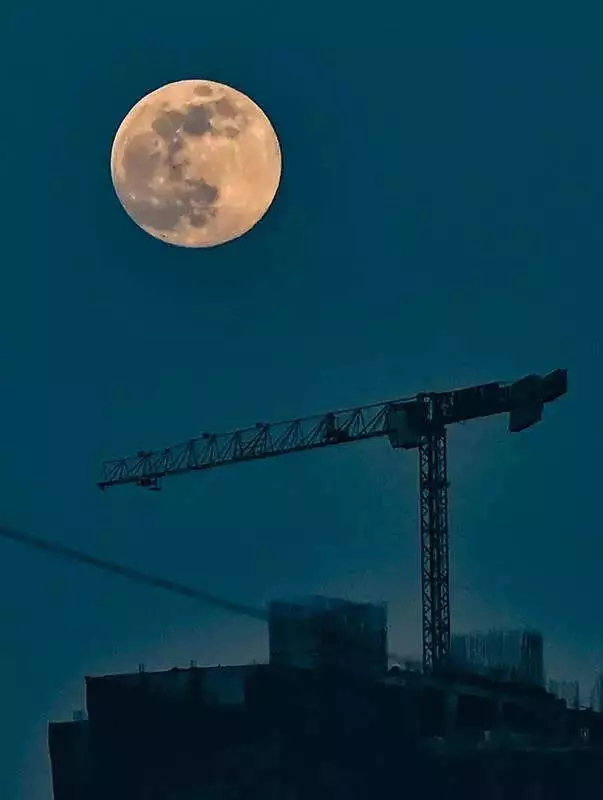
The skies over Nagpur were graced by a spectacular celestial display on Thursday evening as the year's final and brightest supermoon, known as the 'Cold Moon', illuminated the night. The event drew large crowds of citizens, students, and astronomy enthusiasts to mass viewing sessions across the city, including a special observation program at the Raman Science Centre.
The Science Behind the Spectacle
Experts clarified that this supermoon was not just an ordinary full moon but was connected to a rare astronomical cycle. Dr. Govinda Lakhotiya, assistant professor at Dharampeth Science College, explained that the event was linked to the 18.6-year Major Lunar Standstill, a cycle that causes the moon to rise at an unusually high point in the sky. "A supermoon occurs when the full moon coincides with perigee, which is the moon's closest point to Earth," Dr. Lakhotiya said. He noted that Thursday night's Cold Supermoon appeared approximately 14% larger and up to 30% brighter compared to the dimmest full moon of the year.
At the Raman Science Centre, Education Officer Abhimanyu Bhelave addressed visitors, demystifying the phenomenon. He stressed that a supermoon is a scientific event, often misunderstood due to its popular astrological associations. "The Moon travels in an elliptical orbit. When a full moon happens near perigee, people perceive it as unusually big and bright. That is all a supermoon is — simple orbital mechanics," Bhelave stated.

Understanding Lunar Phases and Eclipses
Bhelave further educated the audience on the basics of the lunar cycle. He described how the illuminated portion of the moon changes over its 29.5-day orbit, creating phases like crescent, half, and full moon. "On a new moon day, the moon is near the sun and its dark side faces Earth. As it moves along its orbit, more of its lit surface becomes visible, leading up to the full moon," he elaborated.
He also clarified the key difference between solar and lunar eclipses. A solar eclipse can only occur on a new moon day when the moon positions itself between the Earth and the sun. Conversely, a lunar eclipse is possible only on a full moon night when the Earth's shadow falls on the moon.
A Night of Public Engagement and Observation
The evening provided practical guidance as well, with experts assisting visitors in using telescopes. They shared a useful observation tip: while a supermoon offers a brilliantly bright spectacle, the finer details of lunar craters are best observed during the crescent phase. This is because the long shadows during that phase dramatically enhance the visibility of surface features.
The Raman Science Centre, which regularly hosts public sky-watching sessions every Thursday and Sunday, reported an excellent turnout for this special supermoon event. The night successfully transformed into an engaging blend of scientific education and public spectacle, leaving many first-time observers thrilled by the rare astronomical treat.
Inputs from Aahana Jumde & Nidhi Malghade