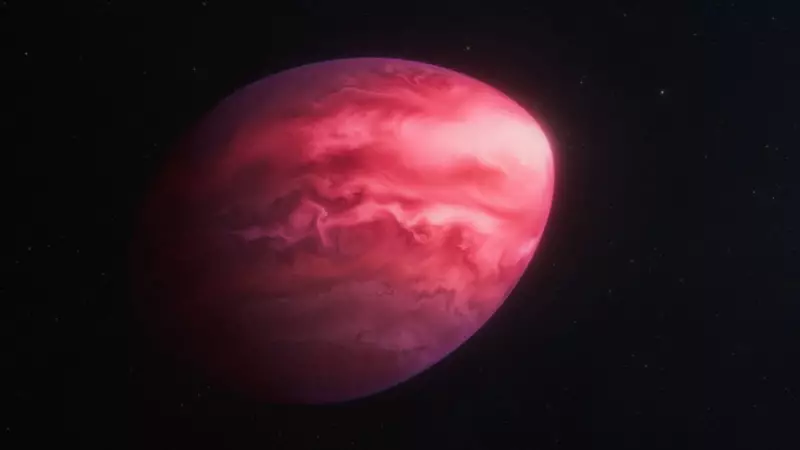
In a groundbreaking discovery, astronomers using NASA's James Webb Space Telescope have identified the most distorted planet ever observed—a bizarre, lemon-shaped world orbiting a rapidly spinning dead star known as a pulsar. This marks the first time scientists have been able to study the atmosphere of a planet circling such a violent stellar remnant.
A World Stretched to the Extreme
While Earth bulges slightly at its equator due to rotation, the newly studied planet, designated PSR J2322-2650b, takes this to an incredible extreme. Its equatorial diameter is a staggering 38% wider than its polar diameter, giving it a distinct lemon or oval shape. This extreme deformation is caused by its incredibly close orbit to its host pulsar.
"It's the stretchiest planet that we've confirmed the stretchiness of," said Michael Zhang, an exoplanet scientist at the University of Chicago and lead author of the study published in The Astrophysical Journal Letters on December 20, 2025. The planet, located over 2,000 light-years from Earth, was originally spotted in 2011 by Australia's Parkes radio telescope.

A Bizarre Atmosphere and a Violent Dance
Using Webb's powerful infrared instruments, the research team made unprecedented observations of the planet's atmosphere. They found it to be utterly alien, devoid of common elements like hydrogen, oxygen, and nitrogen. Instead, it is dominated by helium and molecular carbon.
"A helium- and carbon-dominated world is something we've never seen before," noted co-author Peter Gao, an exoplanet scientist at the Carnegie Institution for Science. This carbon-rich composition suggests the planet could have graphite clouds and possibly even diamonds at its core. Its likely red hue would come from dust and soot-like particles in the carbon atmosphere.
The planet's strange shape and composition are direct results of its hostile environment. It orbits the pulsar at a distance of just 1 million miles, completing a full revolution in about eight hours. The pulsar's immense gravity not only stretches the planet but is actively funneling material away from it. "You have a literal tip, like a point, where material actually comes out of the planet and spirals in," Gao explained.
Is It a Planet or a Dying Star?
The object's extreme properties have led scientists to question its very nature. One compelling theory is that PSR J2322-2650b is not a traditional planet but the remnant of a star being consumed by the pulsar—a scenario known as a 'black widow' pulsar system.
"We favor the star scenario," said Gao, suggesting this might be the final act of cosmic consumption. "It would have lost 99.9% of its mass, and we just happened to catch it right at the very end."
Alternatively, Zhang proposes it could be an entirely new class of astronomical object, one that remains in a stable orbit for billions of years rather than being destroyed. "I hope we have a sibling to compare this object to," he said, expressing a desire to find more such worlds. "If it's continuously losing mass, we had to be really lucky to see it in its last breath before it disappears."
Emily Rauscher, a theoretical astrophysicist at the University of Michigan not involved in the study, summarized the finding: "It's a wacky, weird thing. It's not formed in a way like any normal planet." This discovery by the Webb telescope opens a new window into understanding the diverse and violent fates of celestial bodies in our universe.