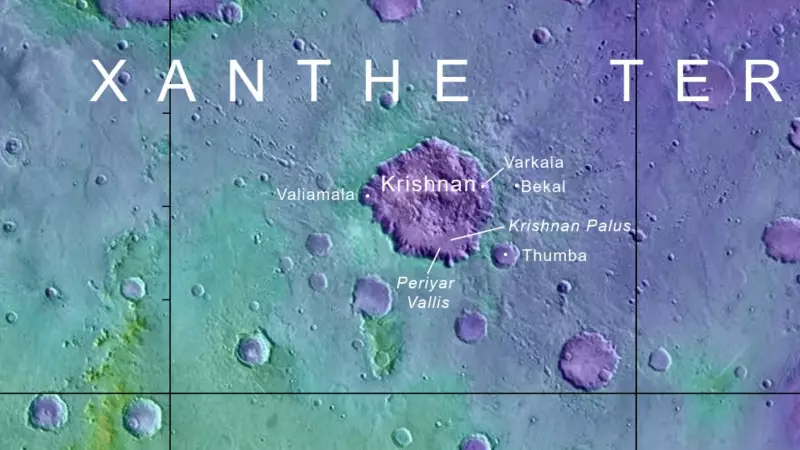
In an extraordinary celestial tribute, a piece of Kerala has found a permanent home on the Red Planet. The International Astronomical Union (IAU) has officially named seven geological features on Mars after iconic Indian locations, with a significant focus on Kerala's landmarks that have played pivotal roles in India's space exploration journey.
Martian Map Gets an Indian Makeover
The International Astronomical Union, the global authority for naming celestial bodies and their features, made this historic announcement on November 24. The newly christened Martian structures honor everything from Kerala's largest river to the birthplace of India's space program, creating a cosmic connection spanning 225 million kilometers.
This naming ceremony represents one of the largest single infusions of Indian names onto the Martian landscape. The recognition comes through the IAU's Working Group for Planetary System Nomenclature, which carefully selects names that reflect diverse cultural and scientific significance.

Kerala's Cosmic Legacy
The Martian features named after Kerala locations cluster around a significant crater named after M S Krishnan, the renowned geologist and first Indian to become director of the Geological Survey of India in 1951. The Krishnan crater itself is a massive 77 kilometers in diameter and is believed to be over 3 billion years old.
Adjacent to this ancient crater, a plain surface measuring approximately 50 kilometers in diameter has been designated as Krishnan Plaus, creating a dual tribute to the pioneering Indian geologist.
Varkala: Geological Twin to Mars
The IAU has chosen a 9 kilometer wide crater along the eastern region of the Krishnan crater to bear the name Varkala. While Varkala beach is one of Kerala's most popular tourist destinations, its geological significance runs deeper. The Varkala cliff contains jarosite remains that offer the closest terrestrial links to Martian land composition, potentially holding crucial clues to understanding Martian evolutionary history.
Thumba: Where India's Space Dreams Took Flight
A crater located southeast of the Krishnan crater now carries the name Thumba, honoring the coastal town where Vikram Sarabhai established the Equatorial Rocket Launching Centre in November 1963. This location marks the birthplace of the Indian Space Research Organisation (ISRO) and continues to host the Vikram Sarabhai Space Centre, often described as the backbone of India's space program.
Valiamala: Home of Space Education
To the west of the Krishnan crater lies Valiamala, a relatively smaller crater measuring 13.5 kilometers in diameter. This name honors the location of the Indian Institute of Space Science and Technology, the premier institution nurturing India's future space scientists and engineers.
Natural Wonders on Martian Soil
The lone Martian valley located along the southern region of the Krishnan crater has been named after Periyar, Kerala's longest river that runs 300 kilometers from the Shivagiri hills in Tamil Nadu to the Arabian Sea near Cochin. This recognition places Kerala's vital waterway among the rare geographical features immortalized on another planet.
Completing Kerala's representation is Bekal, a tiny independent crater measuring 4.9 kilometers in diameter located east of the Krishnan crater. The name comes from the mid-17th century fort in northern Kerala that witnessed the rule of the Keladi Nayaka dynasty, Hyder Ali of Mysore, and later the British Empire.
India's Growing Presence in Space Nomenclature
While these seven names represent the latest Indian additions to Martian geography, they join existing features named after the Ganga river, though those earlier names weren't proposed by India. This growing representation on interplanetary maps reflects India's expanding footprint in space exploration and planetary sciences.

The meticulous naming process by the International Astronomical Union ensures that each feature's designation carries both scientific relevance and cultural significance, creating a permanent record of human achievement and geographical diversity on the Martian surface for generations of explorers and scientists to reference.