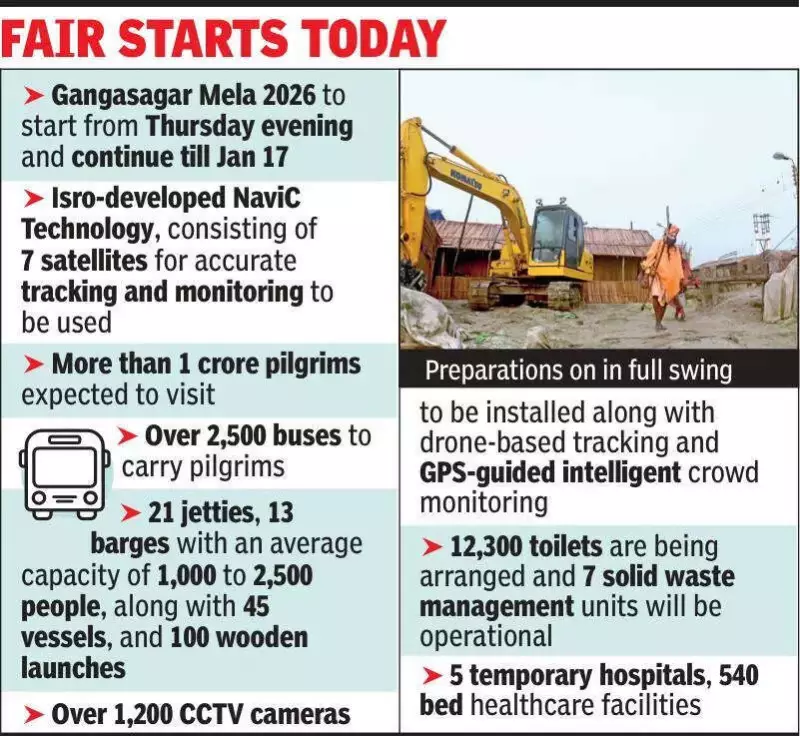
The South 24 Parganas district administration in West Bengal is gearing up for a massive technological deployment to ensure safety and order at the upcoming Gangasagar Mela. With the pilgrimage set to commence on Thursday evening, authorities will harness the power of the Indian Space Research Organisation's (ISRO) indigenous NaviC (Navigation with Indian Constellation) technology to track and monitor the enormous crowds. More than one crore (10 million) pilgrims are anticipated to visit the sacred Sagar Island this year, making robust management systems critical.
High-Tech Surveillance and Crowd Control Measures
For the first time, the administration will integrate ISRO's satellite-based navigation system into its security and logistics framework. The NaviC system, which relies on a constellation of seven satellites and a network of ground stations, will provide accurate real-time positioning and precise timing data. This will be complemented by a multi-layered surveillance grid featuring over 1,200 CCTV cameras, drone-based tracking, and GPS-guided intelligent monitoring systems. To enhance night-time and emergency surveillance, thermal-imaging drones will also be deployed.
Physical crowd regulation is a top priority. A 54-kilometer stretch has been barricaded to control pilgrim movement. A force of 150 NGOs with 10,000 volunteers will be on the ground to assist with management and provide basic health support. For transportation, a fleet of over 2,500 buses will ferry devotees from various locations. Maritime travel will be facilitated through 21 operational jetties, with a substantial deployment of vessels including 13 barges (capacity 1,000-2,500 each), 45 vessels, and 100 launches from Lot 8 and Namkhana.

Comprehensive Pilgrim Amenities and Safety Infrastructure
The administration has left no stone unturned in planning for pilgrim comfort and emergency response. A significant focus has been placed on seamless travel and sanitation. A combined single-ticket system from Kolkata and Howrah to Lot 8 and Kachuberia and back has been introduced for hassle-free journeys. To manage waste, 12,300 toilets have been arranged, supported by seven solid waste management units and three plastic waste management units. In an eco-friendly push, 75 e-carts will collect waste, and 100 solar street lights along with biodegradable bag production units have been installed.
Healthcare preparedness is extensive. The authorities have established 5 temporary hospitals with 125 beds, with an additional 415 beds earmarked. A fleet of 100 ambulances, along with air and water ambulances, will be on standby, backed by 30 critical care units. For disaster management, a formidable team including 2,500 civil defence volunteers, Quick Response Teams (QRTs), deep divers, and personnel from the Navy, SDRF, NDRF, and the coast guard has been assembled. Furthermore, 18 temporary fire stations with 50 fire tenders are positioned at strategic points.
Law, Order, and Traffic Management
Ensuring smooth movement and security is paramount. A dedicated contingent of 15,000 police personnel will be deployed across the Mela grounds. To prevent vehicular congestion, the administration has prepared 16 buffer zones along the route from Babughat to Sagar Mela. Detailed traffic regulation and parking plans have been formulated to facilitate the smooth flow of vehicles and pilgrims alike, creating a safer environment for one of the world's largest human congregations.