

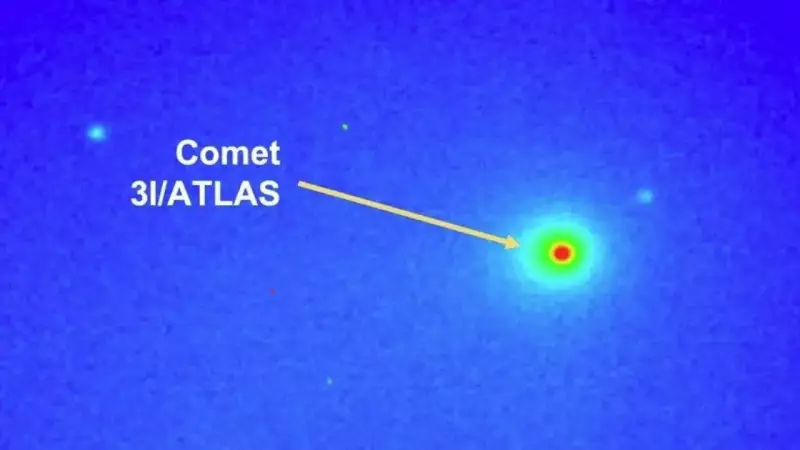
In a significant astronomical achievement, scientists from the Indian Space Research Organisation's Physical Research Laboratory (PRL) have successfully captured detailed images and spectra of the interstellar comet 3I/ATLAS as it journeys away from the inner Solar System.
Groundbreaking Observations from Mount Abu
The research team utilized PRL's advanced 1.2-meter telescope located at Mount Abu to conduct their observations between November 12 and 15. Situated at an impressive altitude of 1,680 meters near Gurushikhar, this sophisticated instrument provided crucial data about the celestial visitor.
The newly acquired images reveal a near-circular coma surrounding the comet's nucleus. This characteristic cloud forms when solar heating causes surface ices to transform directly into gas through sublimation. According to Isro's analysis, "in the present geometry, any dust tail would lie behind the comet relative to the Earth, while deeper multiband images could reveal the ion tail."

Spectroscopic Analysis Reveals Molecular Secrets
During the pre-dawn hours ahead of morning twilight, the research team recorded the comet's light spectrum, uncovering significant findings. The spectral analysis showed clear emission features that align with those observed in Solar System comets, including distinctive molecular bands:
- CN bands
- C2 bands
- C3 bands at shorter wavelengths
Researchers performed detailed calculations to determine the production rates of these molecular emissions, which indicate how much gas releases from the nucleus into the surrounding coma. For comet 3I/ATLAS, these values reached approximately 10²⁵ molecules per second.
Interstellar Visitor Shows Surprising Similarities
One of the most remarkable findings from this study concerns how this interstellar object compares to native Solar System comets. Isro confirmed that "the ratios of these rates place the object among the 'typical comets' of the Solar system despite its interstellar origin."
This discovery suggests that despite originating from outside our Solar System, comet 3I/ATLAS shares fundamental characteristics with comets that formed within our cosmic neighborhood.
The PRL Mount Abu telescope, known for supporting diverse astronomical studies ranging from exoplanet research to high-energy source investigations, continues to contribute valuable data to the global scientific community. The research team has planned additional observations as 3I/ATLAS moves into darker skies, potentially revealing more secrets about this fascinating interstellar traveler.






