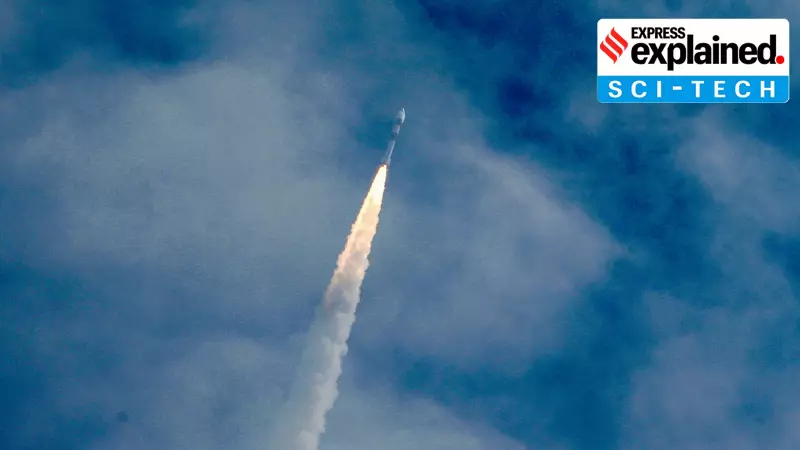
The Indian Space Research Organisation's (ISRO) first launch of 2026 ended in disappointment on Monday, January 12. The trusted Polar Satellite Launch Vehicle (PSLV), designated PSLV-C62, failed to place its payload of 15 satellites into the intended orbit. This marks the second consecutive failure for this workhorse rocket, with both incidents traced to malfunctions in the vehicle's critical third stage.
A Troubling Pattern Emerges
The mission, which lifted off from the Satish Dhawan Space Centre in Sriharikota, Andhra Pradesh, carried a significant payload including seven satellites from foreign customers. The launch proceeded nominally through the first and second stages before encountering trouble during the third stage burn. This mirrors the failure of the PSLV-C61 mission in May 2025, which also faltered after the second stage separation.
Following the May 2025 failure, ISRO Chairman V Narayanan cited an unexpected pressure drop in the third-stage engine's combustion chamber as the cause. While the detailed report from the Failure Analysis Committee was not made public, it was suggested that a manufacturing defect leading to leakage could have been responsible. The cause of Monday's PSLV-C62 failure is still under investigation, but early indications point to a similar third-stage anomaly.

Why the Third Stage is So Critical
The PSLV is a four-stage rocket, with each stage responsible for a specific phase of the ascent. The third stage's role is particularly delicate. After the first stage achieves lift-off and the second stage builds initial velocity, the third stage must rapidly accelerate the vehicle to near-orbital speeds of 26,000 to 28,000 km per hour. This acceleration is necessary to prevent Earth's gravity from pulling the spacecraft back down.
This stage uses solid fuel, which is burned to create high-pressure gas in a combustion chamber. The gas is expelled through a nozzle to generate thrust. Any drop in combustion chamber pressure directly reduces thrust, preventing the rocket from achieving the velocity required to sustain orbit. The vehicle then fails to reach the altitude where the fourth stage can precisely deploy the satellites.
Fallout and the Road Ahead for ISRO
Back-to-back failures represent a significant concern for ISRO. The PSLV has been the agency's primary and most reliable launch vehicle for over three decades, also serving as a major commercial workhorse. Three of ISRO's last six missions have been unsuccessful, an unusually high failure rate that could impact customer confidence and commercial revenue.
Despite this setback, ISRO has a strong history of resilience, thoroughly investigating failures and returning to flight with robust solutions. The space agency's engineers and scientists are now tasked with identifying the root cause of this repeated third-stage issue. Their findings will be crucial not only for returning the PSLV to service but also for ensuring the reliability of future missions, including those involving newer launch vehicles. The global space community will be watching closely as ISRO works to resolve this technical challenge and restore its impeccable launch record.