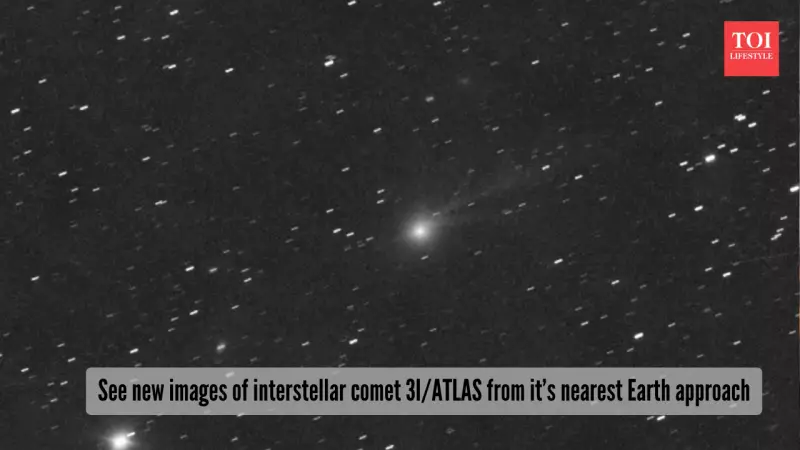
The cosmos has delivered another rare and fascinating visitor. For months, the astronomical community and space enthusiasts have been captivated by the journey of interstellar comet 3I/ATLAS, only the third confirmed object to have travelled to our solar system from the depths of interstellar space. Adding to the intrigue are speculative theories, notably from Harvard scientist Avi Loeb, suggesting it could be an alien probe. This celestial traveller recently reached a significant milestone in its hyperbolic voyage through our neighbourhood.
A Historic Close Approach and Stunning New Images
The comet made its closest pass to Earth on December 19, 2025, at a perfectly safe distance of approximately 270 million kilometres (about 1.8 Astronomical Units), placing it between the orbits of Earth and Mars. It was zipping through space at a staggering speed of 68 kilometres per second. Earlier, on October 29, 2025, it reached perihelion—its closest point to the Sun—at a distance of 203.5 million km, a trajectory that confirms its origins in the deep freeze of another star system, as noted by NASA.
Fresh images captured during this close approach showcase the comet in spectacular detail. A photo from a Utah observatory via iTelescope.Net reveals its bright coma, distinct ion tail, and dust tail, beautifully set against the backdrop of galaxies in the Leo constellation. Astronomers created this composite image by stacking 74 minutes of exposures using a high-end PlaneWave Delta Rho 500 telescope and a ZWO ASI 6200M Pro camera. The resulting photograph clearly shows how solar winds are sculpting the gaseous haze around the comet's nucleus.

Unravelling the Origins and Journey of an Interstellar Wanderer
The story of this visitor began when it was discovered on July 1, 2025, by the ATLAS survey in Chile. It follows in the footsteps of two previous interstellar objects: 'Oumuamua in 2017 and Comet Borisov in 2019. Observations from the powerful James Webb Space Telescope (JWST) have been crucial. Spectroscopy data revealed high levels of carbon monoxide, hinting that this comet formed in an extremely cold environment billions of years ago, possibly within the Milky Way's thick disk.
For sky-watchers in India and around the world, the comet remains visible for a limited time. It can be tracked near the star Regulus using astronomy apps like Stellarium. It is expected to fade from view as it moves towards Jupiter by March 2026. Its long-term path will see it pass by Saturn, Uranus, and Neptune around 2028 before departing our solar system forever, leaving behind a legacy of scientific discovery and posing no collision risk to Earth.
NASA's Unique Observations and the Alien Probe Hypothesis
NASA's fleet of spacecraft provided unique vantage points to study this interstellar guest. The Parker Solar Probe captured a special series of images between October 18 and November 5, 2025. Taking about 10 daily images with its WISPR instrument after its 25th solar flyby, the probe was positioned between 172 and 195 million miles from the comet. It even executed a roll manoeuvre to peer through the solar corona when the view from Earth was blocked, providing invaluable data on brightness and composition.
This data, combined with observations from STEREO, SOHO, and PUNCH missions, is giving scientists an unprecedented look at an object born around another star. While the scientific analysis continues, the comet has also sparked imaginations. The hypothesis from Harvard astronomer Avi Loeb that such interstellar objects could be artificial probes sent by extraterrestrial civilizations has added a layer of popular fascination to 3I/ATLAS's journey, proving that the line between groundbreaking science and captivating speculation is often wonderfully thin.