In the vast, silent expanse of our solar system, astronomers have identified a rare and fleeting visitor from the depths of interstellar space. This celestial traveler, named Comet 3I/Atlas, is only the third such object ever confirmed to have originated from another star system. Its brief journey near Earth offers scientists an unprecedented, and possibly final, opportunity to study the primordial building blocks of a world born around a distant sun.
A Cosmic Wanderer's Journey to Our Doorstep
The discovery of 3I/Atlas was made by the Asteroid Terrestrial-impact Last Alert System (ATLAS) in South Africa on February 22, 2024. Unlike the countless comets and asteroids that permanently orbit our Sun, this object was immediately flagged for its unusual, hyperbolic trajectory. This path, shaped like an open curve, definitively indicated it was not gravitationally bound to our solar system but was merely passing through on a one-way trip from the galactic void.
Comet 3I/Atlas is now the third confirmed interstellar interloper, following the famous and mysterious 'Oumuamua in 2017 and Comet 2I/Borisov in 2019. Its current orbit brings it relatively close to Earth, making it a prime target for observation. However, this window is critically short. The comet is already on its way out, speeding back into interstellar space, and will soon fade from view of even our most powerful telescopes, lost forever.

Why 3I/Atlas is a Scientific Goldmine
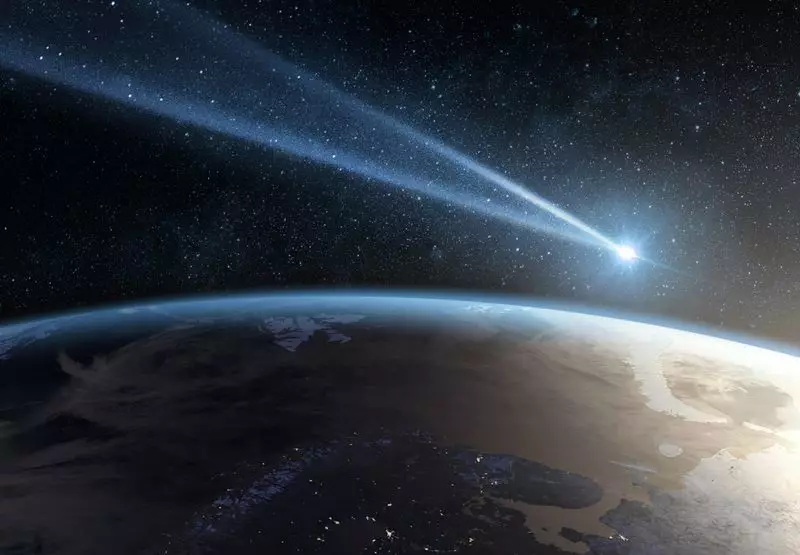
While all interstellar objects are treasures, 3I/Atlas presents a particularly valuable case for astronomers. Its behavior and composition set it apart from its predecessors and provide clearer answers. Unlike the enigmatic, asteroid-like 'Oumuamua, 3I/Atlas has clearly displayed classic cometary activity. As it approached the Sun, it developed a visible coma—a fuzzy atmosphere of gas and dust—and a tail, confirming it is an icy body.
This is crucial because comets are considered cosmic time capsules. They are pristine remnants from the early stages of planetary system formation, preserving the original chemical and physical conditions of their birth cloud. By analyzing the light from 3I/Atlas's coma, scientists can perform spectroscopy to determine its chemical makeup. This data acts as a direct sample, telling us what materials were present around its parent star billions of years ago. Comparing this with comets from our own solar system could reveal if the processes that formed our planets are universal or unique.
Furthermore, 3I/Atlas appears more straightforward to study than Comet Borisov. Borisov fragmented as it passed the Sun, complicating analysis. Early observations suggest 3I/Atlas is holding together, offering a more stable target to understand the structure and strength of these interstellar nomads.
The Hunt for More Interstellar Visitors
The detection of 3I/Atlas so soon after Borisov and 'Oumuamua suggests such visitors may be more common than previously thought. This discovery underscores the growing capability of our sky-survey telescopes, like ATLAS and Pan-STARRS, to detect these fast-moving, faint objects. Each discovery refines our models and predictions about how many interstellar objects traverse our solar system at any given time.
These findings are not just academic; they have profound implications for planetary science and even the search for life. The exchange of material between star systems, a process called panspermia, is theoretically possible via such objects. Studying their composition helps assess whether the basic ingredients for life could be hitchhiking across the galaxy.
The race is now on to collect as much data as possible before 3I/Atlas vanishes. Major observatories worldwide are training their instruments on the comet. While no space mission can be launched to meet it in time, the detailed observations will feed scientific research for years to come. This interstellar visitor, a mere speck of ice and dust, serves as a powerful reminder that our solar system is not an isolated island, but part of a dynamic and interconnected galactic neighborhood where the building blocks of worlds are constantly on the move.