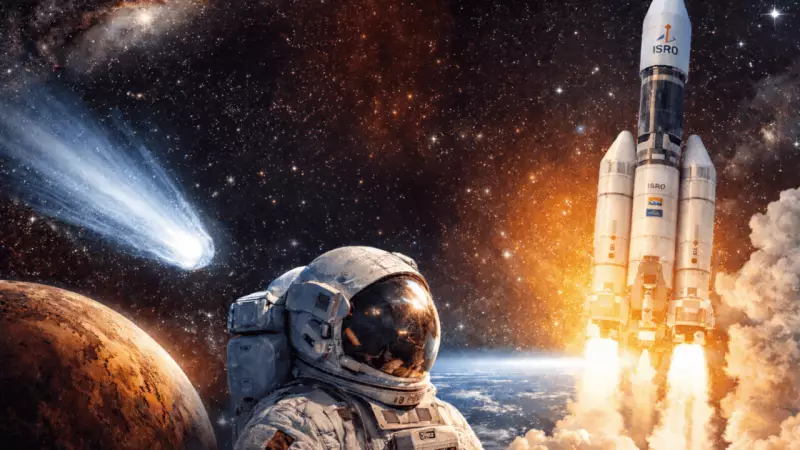
The year 2025 will be remembered as a defining chapter in humanity's quest to explore the cosmos, a year where the spirit of discovery burned brighter than ever. For India, it marked a period of unprecedented achievement, propelling the nation firmly into the elite league of global space powers. From groundbreaking technological feats in orbit to significant contributions aboard the International Space Station, India's space agency, ISRO, demonstrated a remarkable blend of ambition, precision, and collaborative spirit.
India's Cosmic Crescendo: A Year of Historic Firsts
India's journey through 2025 was nothing short of spectacular, marked by a series of missions that expanded the country's capabilities and international standing. ISRO Chairman V. Narayanan highlighted that the sector recorded over 200 significant accomplishments throughout the year, signaling a rapid acceleration in pace and complexity.
The year began with a monumental success on January 16, when ISRO's Space Docking Experiment (SpaDeX) mission saw two satellites, SDX-01 and SDX-02, autonomously rendezvous and dock in Low Earth Orbit. This critical achievement made India the fourth nation after Russia, the US, and China to master orbital docking, a technology vital for future space station assembly, satellite servicing, and crewed missions.

Merely days later, on January 29, ISRO celebrated its historic 100th successful launch from Sriharikota, deploying the NVS-02 navigation satellite. This milestone, spanning from the first SLV-3 launch in 1980, underscored the program's legendary reliability and cost-effectiveness.
Human Spaceflight and Global Partnerships
India's presence extended to the International Space Station (ISS) in 2025. Group Captain Shubhanshu Shukla, a distinguished IAF pilot, made history as the first Indian to live and work aboard the ISS as part of the Axiom-4 (Ax-4) mission. His safe return on December 15, 2025, provided invaluable experience for India's upcoming Gaganyaan human spaceflight program.
International collaboration reached new heights with the July 30 launch of the NASA-ISRO Synthetic Aperture Radar (NISAR) satellite. Equipped with the world's largest radar antenna, this joint mission is set to revolutionize Earth observation for climate science, disaster management, and ecosystem monitoring.
The Grand Finale: Bahubali's Record-Breaking Flight
The year culminated in a powerful statement of technological prowess on December 24, 2025. ISRO's LVM3-M6 rocket, nicknamed "Bahubali," successfully launched the 6,100 kg BlueBird Block-2 satellite—the heaviest payload ever lofted from Indian soil. The satellite is part of a global constellation providing direct-to-mobile 4G and 5G connectivity worldwide.
The flawless launch from Sriharikota at 8:55 am, followed by a perfect orbital insertion, showcased ISRO's operational excellence. "With nine consecutive successful LVM3 launches, our confidence in the Gaganyaan mission has significantly increased," stated Chairman Narayanan. ISRO also released stunning onboard camera footage, offering a rocket's-eye view of the entire mission from liftoff to satellite deployment.
Global Discoveries: From the Sun to Interstellar Visitors
While India soared, the global scientific community made profound discoveries. NASA's Parker Solar Probe created the first continuous 2D map of the Sun's outer corona, revealing how its Alfvén surface—where solar wind escapes—becomes rougher during active solar cycles. This data is crucial for predicting solar storms that can disrupt technology on Earth.
Around the bright star Fomalhaut, 25 light-years away, the Hubble Space Telescope captured violent asteroid collisions, offering a real-time glimpse into the chaotic processes that shape planetary systems. Meanwhile, astronomers tracked interstellar comet 3I/ATLAS, the third confirmed visitor from another star system, using a fleet of NASA assets including Mars orbiters and the Perseverance rover.

The exoplanet catalogue continued to swell, with confirmed worlds surpassing 6,000. Studies of these distant planets, some orbiting binary stars and others with resilient atmospheres, are refining the search for habitable environments beyond our solar system.
Expanding the Frontier: Commerce and Anniversary
The commercial space sector gained tremendous momentum. SpaceX advanced its Starship program, Blue Origin's New Glenn rocket completed its maiden flight, and commercial lunar landers like Firefly Aerospace's Blue Ghost achieved successful Moon touchdowns under NASA's CLPS program.
The International Space Station celebrated 25 years of continuous human presence on November 2, 2025. This orbiting laboratory remains a testament to international cooperation, hosting thousands of experiments that pave the way for future missions to the Moon and Mars.
Looking Ahead to 2026 and Beyond
The momentum from 2025 sets the stage for an even more ambitious future. The global community looks toward NASA's Artemis II mission for a human return to the Moon. India is intensifying preparations for its landmark Gaganyaan mission while planning expanded international collaborations. The rapid growth of commercial spaceflight and satellite mega-constellations promises to further democratize access to space, turning 2025's triumphs into a springboard for the next giant leap.